


This week’s numbers pull in different directions, and that is worth seeing on paper. The ISM manufacturing index posted its strongest reading since 2022, with every subindex in expansionary territory, while construction spending unexpectedly contracted and the 30-year mortgage rate climbed to its highest level in over a year. On the earnings side, the share of S&P 500 companies beating Q2 estimates hit a record, and the index’s earnings level now sits 14% above a trend channel that goes back more than 90 years. Add a New York Times map showing planned data center capacity dwarfing what exists today, three Fed dissenters arguing for rate hikes, and a research team that built an AI simulation of the FOMC itself, and you have a full picture to work through. The charts below lay it all out.
US Economy
The Employment Cost Index rose a tad more than expected, driven by sustained strength in benefits costs, while growth in wages and salaries softened.
The ISM manufacturing PMI hit the strongest level since 2022. All subindices were in expansionary territory. Output surged. New orders edged up. Employment leapt back into expansionary territory.
Construction spending contracted unexpectedly in June, driven by weakness in residential construction. Data center construction spending continues to surge, further widening the lead over general office construction. Growth in data center construction spending reaccelerated. The Atlanta Fed’s GDPNow model is now tracking Q3 GDP at 5.8%, down from 5.9% on August 4.
New Yorkers are the most rent-burdened residents in the US, with nearly 40% of their income spent on rent. The US Commercial Real Estate (CRE) market has just been through its third major correction in 40 years.
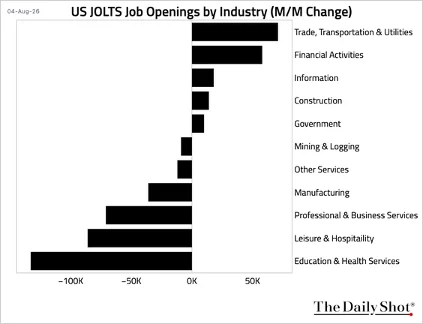
The June JOLTS report showed that job openings edged down.
This chart shows the changes in job openings by industry.
The jobs-workers gap, which measures the difference between labor supply and labor demand, has rebounded and remained near equilibrium. Initial jobless claims edged up but remained near secularly low levels, signaling limited layoffs. Continuing claims edged up but remained lower than in the same period last year. US Challenger job cuts declined to a two-year low. Technology remained the largest source of cuts, with AI-related reductions continuing to be the top announced reason. Smoothed on a rolling three-month basis, Revelio’s estimates show continued momentum in job gains.
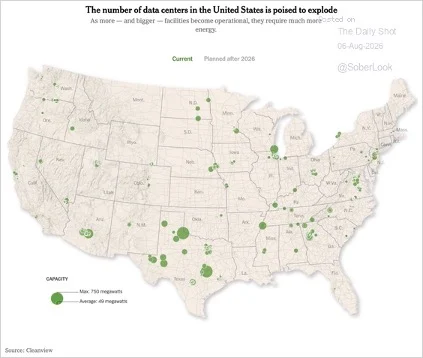
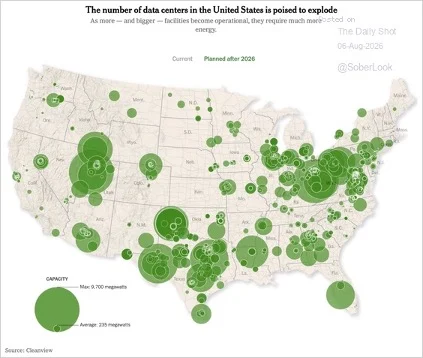
The number of data centers in the US is poised to explode.
- Current:
Source: The New York Times
- Planned:
Source: The New York Times
Nonfarm productivity picked up in the second quarter and handily beat consensus.
The 30-year mortgage rate rose to its highest level since July 2025, extending a five-week climb that is worsening housing affordability.
US Stock Market
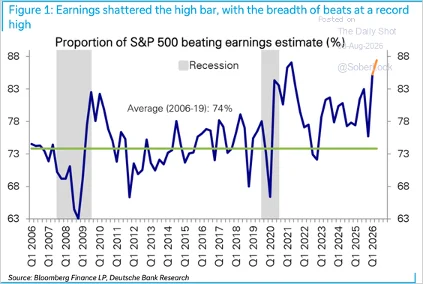
The proportion of S&P 500 companies beating earnings estimates in Q2 is at a record high.
Source: Deutsche Bank Research
Analysts continue to raise EPS forecasts for the rest of 2026.
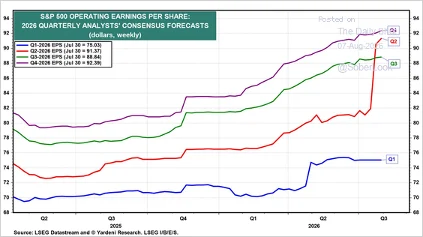
Source: Yardeni Research
The calendar-year earnings revisions are much stronger than historical norms.
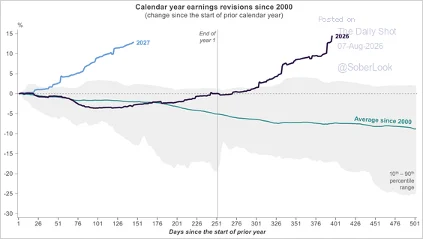 Source: Truist Wealth
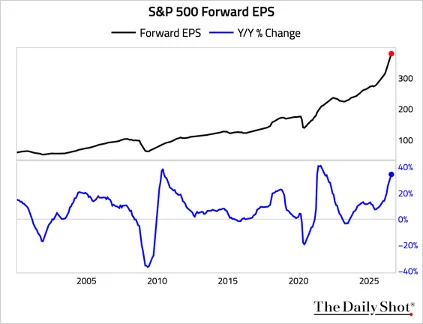
- Growth in forward EPS has been accelerating.
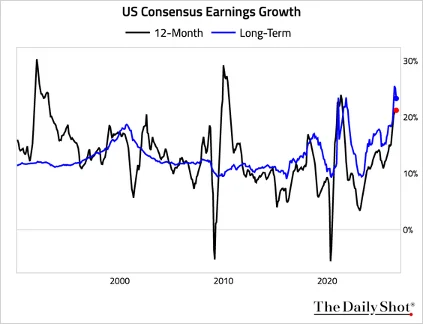
- Both short- and long-term consensus earnings growth rates remain high.
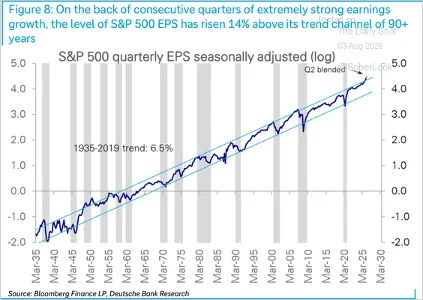
The level of S&P 500 EPS is now 14% above its long-term trend channel.
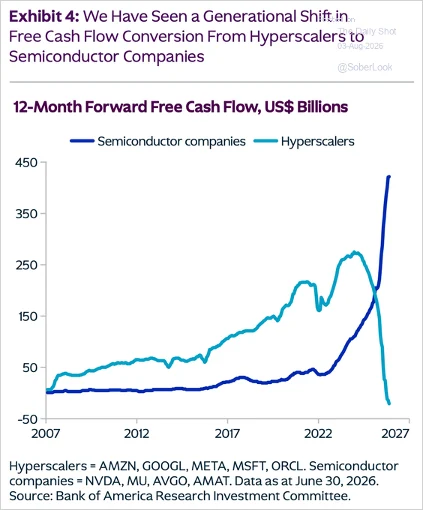
We have seen a generational shift in free cash flow conversion from hyperscalers to semiconductor companies.
Global earnings have been strong and revisions have continued to rise. Profit margins continue to rise, with margins for companies outside tech breaking out of the recent narrow range.
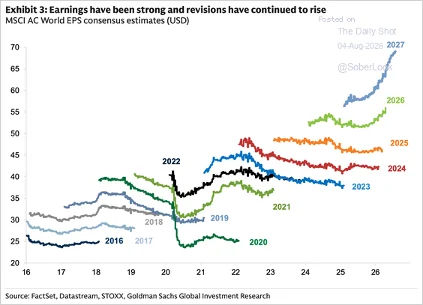
Source: Goldman Sachs, “Momentum, rotation and the value in growth” (August 2026)
Consensus expects hyperscaler capex at over 3% of GDP for the next three years, higher than the GDP share of telecom’s capex in the 2000s, but lower than residential investment’s share before the global financial crisis. The pace of capex growth is expected to slow down in the first half of 2027, and free cash flow is expected to inflect higher in the second half of 2027.
SpaceX’s IPO lockup begins to unwind last Friday with up to 911.5 million insider shares becoming eligible for sale, the first tranche of a staggered release schedule.

The Fed
Three Fed dissenters urged near-term rate hikes to prevent persistent inflation from becoming entrenched.

Source: @economics Read full article
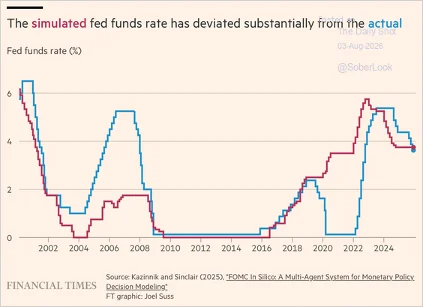
Researchers built a multi-agent LLM framework to simulate the FOMC decision process, with each agent representing an FOMC member receiving real-time macroeconomic data. The chart below shows the simulated and actual Fed funds rate. For July, the Financial Times also ran a simulation, with AI personas unanimously predicting a 25-basis-point Fed rate increase, citing persistent above-target inflation and de-anchored expectations.
The New York Fed’s multivariate core trend inflation measure decelerated in June.
Great Quotes
“You can avoid reality, but you cannot avoid the consequences of ignoring reality.” – Ayn Rand
Picture of the Week
Lake Pehoe, Chile

All content is the opinion of Brian Decker












Leave A Comment