

The US economy is running through its sixth-longest expansion on record, and this week we step back to put that in context. We look at what more than two hundred years of GDP and market returns show about long-run American growth, then bring it current with the latest ISM services reading, record-high trucking spot rates, and the June jobs report. We also cover where the stock market stands beneath a surface led by a handful of mega-cap names, and the five task forces Fed Chair Kevin Warsh has created to rethink how the Federal Reserve handles communications, its balance sheet, data, productivity, and inflation.
US Economy
The current business cycle expansion is the sixth longest in history.
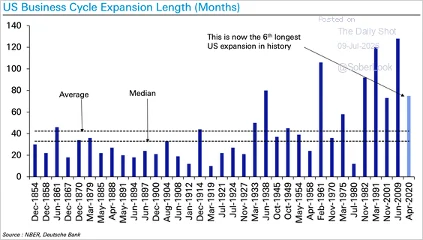
Source: Deutsche Bank Research
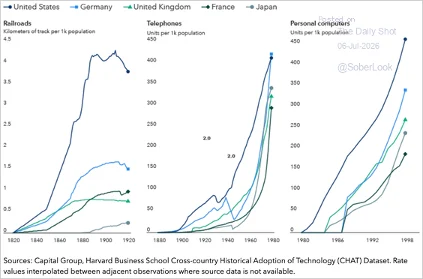
America, home to just 4% of the global population, remains a powerful force in the global economy.
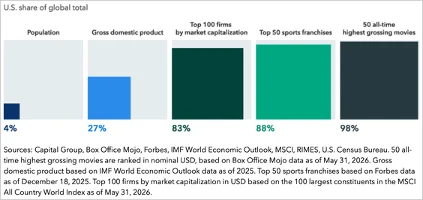
Source: Capital Group Read full article
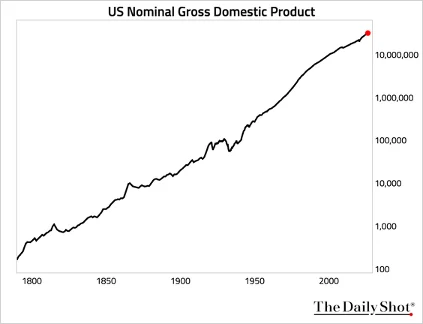
Nominal GDP has expanded from an estimated $160 million in 1789 ($7.5 billion in 2026 dollars) to $31 trillion today.
Source: MeasuringWorth
Real GDP has expanded over 4,000 times, growing at an annualized rate of 3.6%. Americans have often been early adopters of new technologies, …
Source: Capital Group
… and the country continues to lead the world in R&D spending. One dollar invested in stocks at the start of 1800 would’ve grown to nearly $67 million, compounding at an annualized return of 8.3%. After inflation, the terminal value becomes $2 million for an annualized return of 6.6%. Bond returns are more modest, with one dollar invested in US government bonds at the start of 1800 growing to a little over $44,000 for an annualized return of 4.8%. On an inflation-adjusted basis, the terminal value is about $1,300, corresponding to an annualized return of 3.2%.
The ISM Services PMI moderated, signaling a slight cooling in the sector’s still-robust expansion. All subindices were in expansionary territory. The business activity index dipped,
so did the new orders component. The employment index jumped into expansionary territory. The backlog of orders index rose, indicating that business demand is now significantly outpacing capacity. The prices paid index eased, falling to its lowest level since February. The final S&P Global Services PMI for June was revised down slightly. New business growth accelerated to its fastest pace since February, driven by domestic demand, but new export business declined for the seventh consecutive month.
US trucking spot rates surpassed $4 per mile for the first time on record despite plunging retail diesel prices, underscoring exceptionally tight freight capacity.
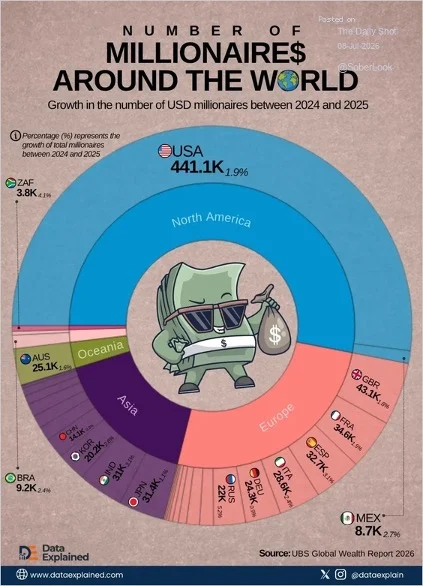
Here’s a look at millionaires around the world.
Source: Voronoi by Visual Capitalist Read full article
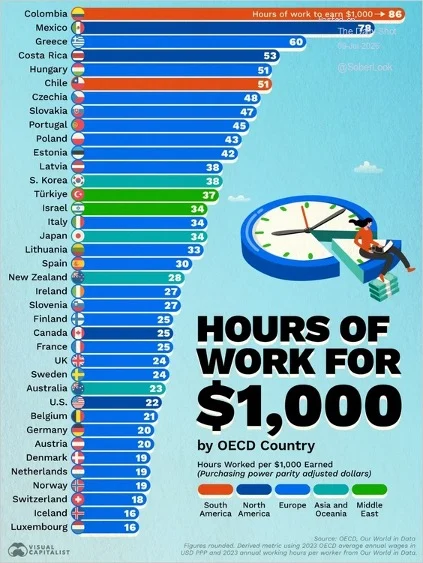
How many hours do workers need to work to earn $1,000?
US Stock Market
The rally in the S&P 500 since the end of 2022 is the most impressive on record.
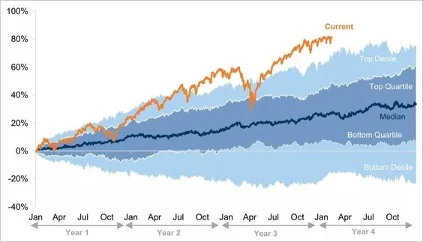
Source: Goldman Sachs via Daily Chartbook
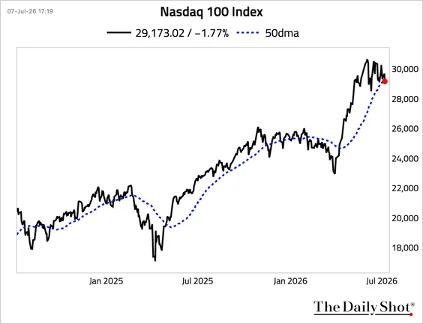
The Nasdaq 100 fell below its 50-day moving average.
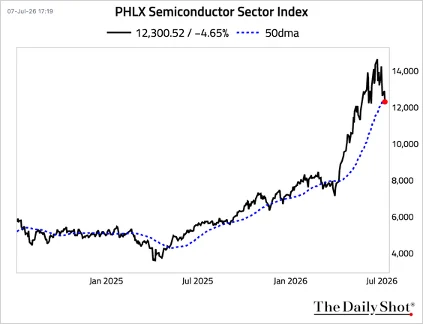
The semiconductor sector index also fell below its 50-day moving average, …
Analysts continue to revise EPS forecasts for 2026 upward.
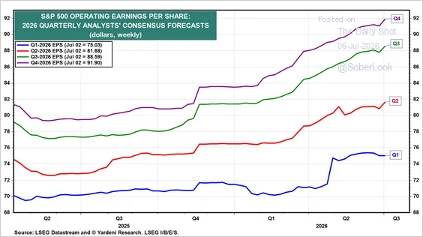
Source: Yardeni Research
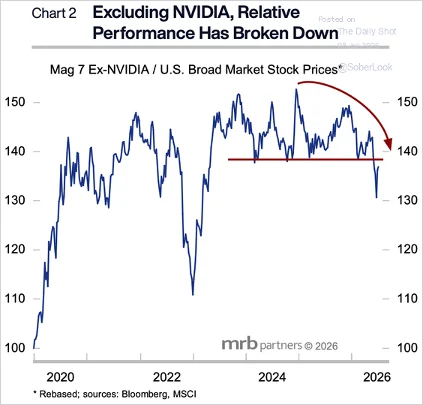
Excluding NVIDIA, the relative performance of the other Mag 6 stocks has decisively broken below the trading range in place since late 2023.
The Russell 2000’s forward 12-month P/E falls from 33x to 16x when unprofitable companies are excluded, highlighting how loss-making firms materially inflate the index’s headline valuation.
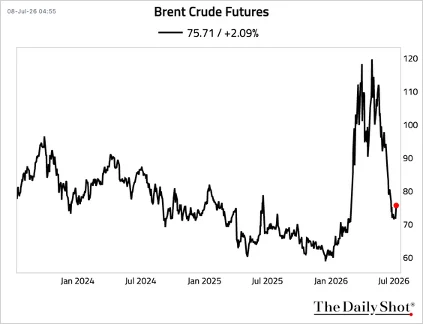
Oil prices jumped after the US and Iran traded fire. President Trump declared the ceasefire effectively over.

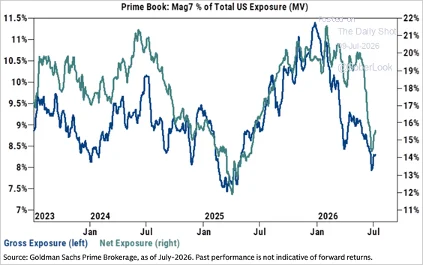
Goldman’s hedge fund clients have sharply reduced both gross and net exposures to Magnificent Seven stocks to three-year lows.
Source: Goldman Sachs
The Fed
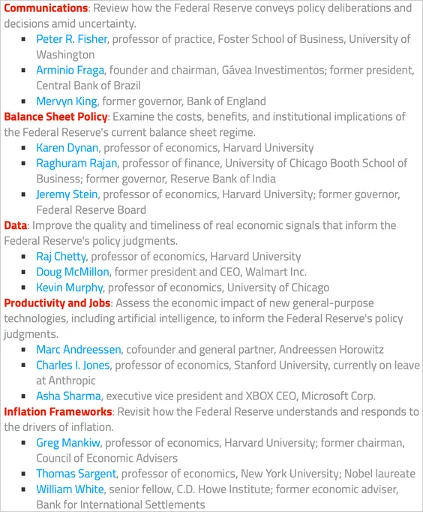
The new Federal Reserve Chairman Kevin Warsh announced at the beginning of his term that he would create 5 taskforces to deal with various topics:
- Communications: Warsh is clearly on record as not being in favor of the forward guidance to the extent that it developed under Bernanke, Yellen and Powell. He did not offer a dot plot in his first meeting. He wants a complete rethink.
- Balance sheet policy: Warsh would like to reduce the balance sheet and shorten the duration of his portfolio.
- Improving data: we all know that the data the Federal Reserve gets from the BLS and other government agencies is outdated and the methodologies are suspect in a modern era. Should the Fed collect its own data or work with the government agencies to improve their methodology? I have talked about this in the past and there are ways to do this but it is not simply tinkering around the edges of data collection. There needs to be wholesale changes and modernization.
- Productivity and jobs: arguably this (employment) is one of the assignments that Congress has given to the Fed but the linkage between monetary policy and jobs is not clear.
- The most important task force? In my mind it is the one on inflation. Warsh wants to revisit how the Federal Reserve understands and responds to the drivers of inflation.
When I first read about the Task Forces, I was admittedly a little skeptical. Another blue-ribbon committee making suggestions that will be thrown into the mind-numbing bureaucratic maw, chewed up and “processed” and passed through the system ending up as the same old… stuff.
Please note: I am a huge fan of Kevin Warsh. He is clearly changing the culture at the Federal Reserve. This is the regime change that not many people are talking about. But as we have found, regime changes are more difficult than simply saying the words.
Then Thursday I looked at the people that he appointed to the taskforces. The one that stood out to me immediately was his task force on inflation:
- Greg Mankiw, professor of economics, Harvard University; former chairman, Council of Economic Advisers
- Thomas Sargent, professor of economics, New York University; Nobel laureate
- William White, senior fellow, C.D. Howe Institute; former economic adviser, Bank for International Settlements
Thomas Sargent and Bill are hellbent on taming inflation. Bill White, when he was the Chief Economist at the Bank of International Settlements, consistently fought with central banks and governments over inflation. Nobel laureate Tom Sargent is one of the true conservative Nobel laureates and whose research reinforces the points about inflation and fiscal policy, along with a number of other topics. I know both of these gentlemen. Greg Mankiw is a well-known conservative economist at Harvard.
His task force on productivity and jobs? Marc Andreessen (Andreessen Horowitz) and Asha Sharma, executive vice president and XBOX CEO, Microsoft Corp. The one academic, Charles I. Jones, professor of economics, Stanford University, is currently on leave at Anthropic. Three very serious thinkers to understand the impact of AI on jobs and productivity as well as normal business practice. All-Star team.
I do not want to go into the weeds on each task force, but they are all of the same cloth. People with deep understanding of their topics and aware of the need for dramatic change in directions. Clearly Warsh has been planning this for a very long time.
Warsh in his speeches and publications has been very clear that he expects things to change at the Federal Reserve. The people he has appointed to these task forces simply double down on that expectation.
This is a potential major sea change in central bank policy. It is coming at us at the same time as the Japanese central bank is also making changes. The yen is continuing to weaken (finally). The Japanese central bank could raise rates more, which would give strength to the yen but that also has consequences. If the BOJ buys bonds, that will be seen by the market as quantitative easing and inflationary.
What they have elected to do this week is to “encourage” Japanese pension funds to sell foreign government bonds (read US) and buy Japanese bonds. That would both support their bond market, increase the value of the yen and not be a shock to their stock market. Just one fund alone has almost $2 trillion in assets. It is conveniently controlled by the Bank of Japan. What do you do when the boss encourages you to do something? And if you’re an independent Japanese pension fund, when your central bank comes to you making suggestions, what do you do?
This will complicate Chairman Warsh’s life as he needs more buying of US treasuries, not less. This will not happen overnight, but it will be a direction that will work its way through US yields, even if on the margin.
People are policy and the people that Kevin Warsh has put on the committees should send a big signal to the markets. It should also send the same signal to Congress, but they will ignore it until there is a fiscal crisis. Hopefully by the time we have a crisis, Warsh has his team and policies in place to be able to force Congress to deal with their own fiscal dysfunction. It will take a great deal of fortitude and courage, but I believe he is the man for the job.
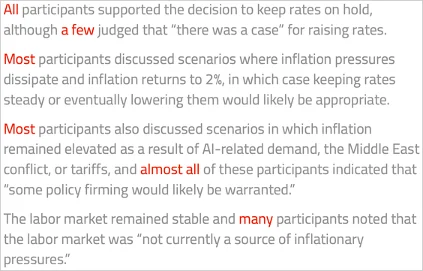
Our FOMC Minutes Sentiment Indicator turned the most hawkish since 2022.
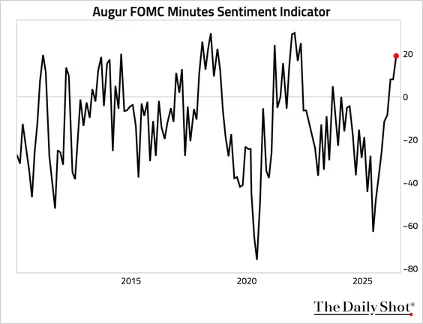
– Here are some highlights from the minutes.
Mortgage applications fell as the 30-year fixed mortgage rate ticked up.
Federal Reserve Chair Kevin Warsh has named leaders for five task forces to review the Fed’s communications, balance sheet, data, productivity, and inflation frameworks.
Jobs
The June jobs report showed lower-than-expected employment growth following a string of good months. That was disappointing, but did it change the trend? Not yet, according to this chart. The bars show each month’s job growth while the three-month moving average smooths out the month-to-month volatility. The trend turned upward in late 2025.
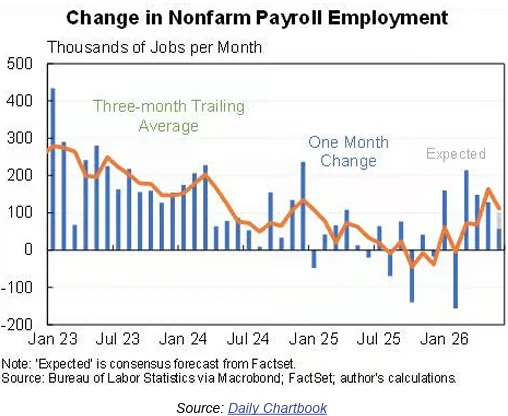
The June number bent the moving average downward, but it’s still at an 18-month high. While recent data is still subject to revision, that 2025 weakness appears to be receding. This isn’t the kind of labor market weakness that typically causes the Fed to cut interest rates. Here’s another look at the employment picture, this time showing total payrolls by month instead of the monthly change in that total. This illustrates the trend in a different way.
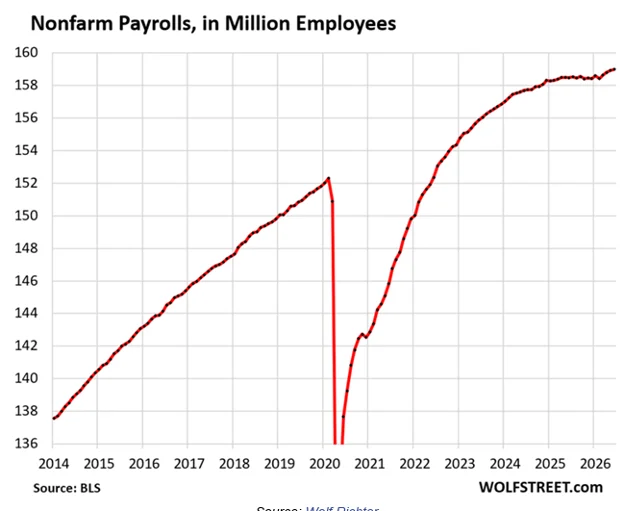
Look first that the pre-COVID trend. Notice it grew at a generally smooth angle from 2014 to 2020. The post-COVID recovery produced even faster job growth, bringing the total back where the prior trend would have taken it by late 2023. From there, the number of people with jobs kept growing but not as quickly. By 2025 the line was almost flat. Now it’s bending upward again. The critical question is whether this continues.
Great Quotes
“Bull markets are born on pessimism, grow on skepticism, mature on optimism, and die on euphoria.”
– Sir John Templeton
Picture of the Week
Lotus flower

All content is the opinion of Brian Decker