


Stocks are near highs, but what you’re paying for future earnings varies widely by sector. Below we show how today’s prices compare with history, why the cushion over bonds is thin, and what that means for setting expectations without stretching risk.
One of the hallmarks of very late-stage bull market cycles is the inevitable bashing of long-term market valuation metrics. In the late 90s, if you were buying shares of Berkshire Hathaway, it was mocked as “driving Dad’s old Pontiac.” In 2007, valuation metrics were dismissed because the markets were flush with liquidity, low interest rates, and “Subprime was contained.”
“Valuation is the capstone of proximate causes for a market top, and the one most indicative of the potential magnitude of any subsequent selloff. It’s well known that valuations are high for the US market, but I thought I’d update my aggregate indicator, which combines the main measures of long-term stock-market worth. It previously peaked in April, but has just made a new all-time high this month. Not a welcome sign if you’re a long-term bull.” – Simon White, Bloomberg
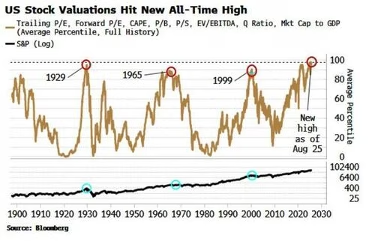
Multiple valuation gauges (P/E, CAPE, P/B, EV/EBITDA, P/S, Q, market-cap-to-GDP) sit at record highs—surpassing the 1929, 1965, and 1999 peaks. Source: Bloomberg.
Of course, just as we have seen so many times, we again see repeated arguments about why “this time is different.” For some, it is the belief that the Fed will bail out markets if something goes wrong. For others, “Artificial Intelligence” and “Cryptocurrencies” are a new paradigm of investment returns. Of course, it is hard to blame investors for feeling this way, given the market’s outsized gains over the last 15 years.
Regardless of the reasoning, there is little argument that current trailing market valuations are elevated.
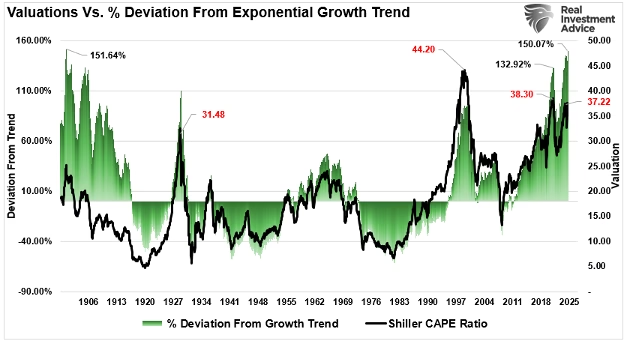
Valuations remain far above the long-run growth trend—levels comparable to prior major market tops—with CAPE still elevated. Source: Real Investment Advice.
However, we need to understand two crucial points about valuations.
- Market valuations are not a catalyst for mean reversions, and;
- They are a terrible market timing tool.
Furthermore, investors often overlook the most essential aspects of valuations.
- Valuations are excellent predictors of return on 10 and 20-year periods, and;
- They are the fuel for mean-reverting events.
Critics argue that valuations have been high for quite some time, and a market reversion hasn’t occurred. However, to our point above, valuation models are not “market timing indicators.” The vast majority of analysts assume that if a measure of valuation (P/E, P/S, P/B, etc.) reaches some specific level, it means that:
- The market is about to crash, and;
- Investors should be in 100% cash.
This is incorrect.
Market valuation measures are just that—a measure of current valuation. Moreover, market valuations are a much better measure of “investor psychology” and a manifestation of the “greater fool theory.” This is why a high correlation exists between one-year trailing valuations and consumer confidence in higher stock prices.
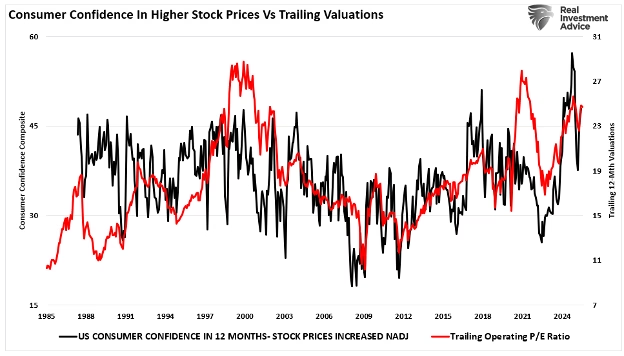
Investor optimism and trailing P/Es often move together; both are near cycle highs, signaling sentiment-rich valuations. Source: Real Investment Advice.
What market valuations express should be obvious. If you “overpay” for something today, the future net return will be lower than if you had paid a discount for it.
Current market valuations are not sustainable. Fundamentals, revenue growth, earnings power, free cash flow, margins, and debt govern valuation over time. This is particularly true when the vast majority of the market generates little to no earnings growth, but growth is only a function of a handful of companies.
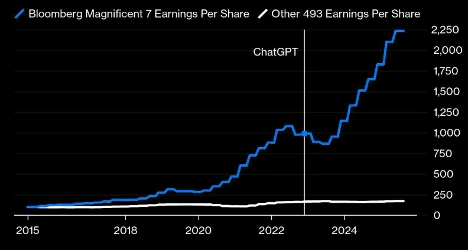
A handful of mega-caps have powered most EPS growth in the AI era, while earnings for the rest of the index are comparatively flat. Source: Bloomberg.
Markets eventually will revert toward fundamentals. That process takes time, but it is both inevitable and relentless
The Price‑to‑Sales (P/S) ratio measures how much investors pay for each dollar of a company’s sales. The S&P 500 currently trades around 3.2 times trailing sales. The long‑term average is closer to 1.6 times. For perspective, a P/S ratio above “2″ signals elevated valuations. The market P/S ratio is currently more than 2-standard deviation above its historic average.
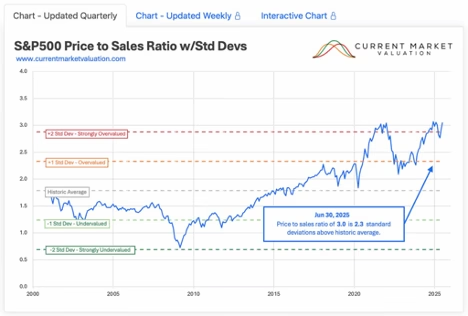
The S&P 500’s P/S sits well above its long-term norm—historically associated with lower forward returns. Source: CurrentMarketValuation.com.
The elevated P/S reflects bullish expectations that when you pay over $3 per $1 of sales, you expect future growth to justify it. That means investors expect strong revenue gains ahead. But if growth slows, valuations must adjust downward. In other words, the market is currently “priced for perfection,“ which leaves a lot of room for disappointment.
Another measure is Market‑Cap‑to‑GDP, known as the Buffett indicator. This measure compares total stock market value to national output. Given that earnings and revenue growth come from economic activity, the market valuation should represent the strength of the overall economy. Currently, that measure of market valuation resides at 217%. Notably, the long‑term average is around 155%. At current levels, valuations are well above what the economy can generate, and two standard deviations above the long-term trend.
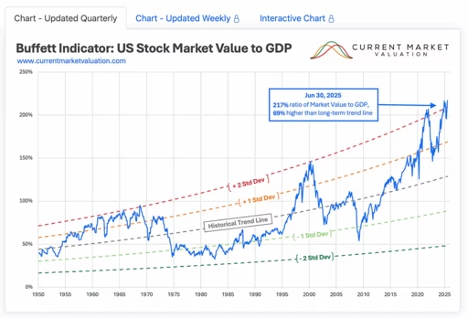
Market cap-to-GDP remains extremely elevated (~217%, about 69% above trend), underscoring rich aggregate pricing. Source: CurrentMarketValuation.com.
That signals broad market overvaluation versus economic size. It suggests prices may be disconnected from the real economy that generates earnings.
Both metrics send a clear message: valuations exceed long‑term norms. That means excess return potential is limited. Downside risk rises if sentiment shifts or fundamentals falter.
These high valuations can be sustained longer than expected if sentiment remains jubilant. But you cannot ignore the math. Expectations already baked into the price are high. Therefore, you must realize that you tolerate a limited margin of safety unless fundamentals outperform.
Great Quotes
“Have you ever noticed that anybody driving slower than you is an idiot, and anyone going faster than you is a maniac?” — George Carlin
Picture of the Week
Elephant Rock, Iceland

Elephant Rock, Heimaey (Westman Islands), Iceland—a natural basalt formation that strikingly resembles an elephant sipping from the sea.
All content is the opinion of Brian Decker