


The week gave you a lot to sort through, and several of this week’s readings point in opposite directions. Growth tracking softened while manufacturing surveys firmed. Job cuts rose in one report even as payroll data held up in another. Corporate margins reached record highs at the same time the Fed flagged stronger inflation pressure. And AI now sits at nearly half the S&P 500’s market cap. Below is a roundup of where the economy, the markets, and the Fed stand right now.
US Economy
The Atlanta Fed’s GDPNow model is now tracking Q2 GDP at 3%, down from 3.8% on May 28.
The goods trade deficit narrowed more than expected in April, driven by a significant jump in exports that outpaced the rise in imports. Exports of crude oil and petroleum remained higher than usual. Capital goods imports continued to surge as businesses ramped up purchases of AI-related hardware. Nonfinancial corporate margins were strong in Q1.
The Chicago PMI surged back into expansionary territory and handily beat consensus estimates.
US CEO confidence fell in Q2, as CEOs grew markedly more pessimistic about economic conditions, while maintaining generally steady capital-spending plans and a cautious “low-hire, low-fire” approach to employment.
The ISM manufacturing PMI accelerated to a four-year high. Firms boosted orders and production amid supply chain disruptions. Construction spending increased in April, surpassing consensus estimates, driven by strength in private residential construction, which offset a pullback in non-residential activity. Data center construction spending surpassed $50 billion for the first time, widening the lead over general office construction. Strength in business activity has offset the moderation in consumption growth.
The S&P Global manufacturing PMI was revised down slightly but remained at the highest level since May 2022, with stronger output and new orders offset by softer employment.
Initial jobless claims increased to 225,000, above consensus estimates. Continuing claims edged down, suggesting that despite some weekly volatility in new claims, laid-off workers continue to find new employment relatively quickly. Announced job cuts rose in May, with technology firms announcing the most cuts in nearly two years. Total job cut announcements were down over the past five months compared with the same period a year earlier. Bank of America’s internal data show payrolls grew briskly in May. • Here’s a look at monthly changes in employment by sector.
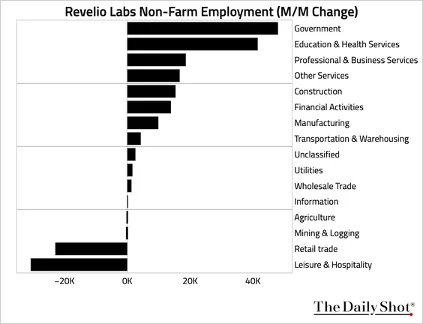
Revelio’s estimates show some upward momentum in the labor market, consistent with Bank of America’s data above and the ADP report. With unit labor costs growing at the lowest year-over-year pace in five years, the labor market is unlikely to be a source of inflationary pressure this year.
Bank of America’s total card spending per household rose 5.2% year over year in the week ending May 30.
US Stock Market
The market has delivered its strongest start to a midterm-year second quarter since 1950, despite entering what is typically one of the weakest periods of the presidential cycle.
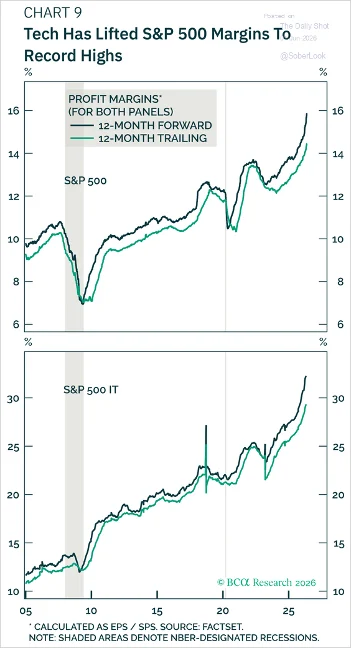
Software stocks posted the strongest month since 2001, as strong earnings and AI-driven demand eased fears that artificial intelligence would disrupt the sector’s growth prospects. S&P 500 margins have surged to record highs, aided by the tech sector.
The S&P 500’s response to the Iran conflict has gone from one of the worst following a geopolitical shock to one of the best.
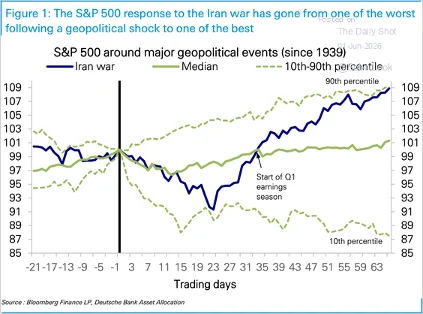
Source: Deutsche Bank Research
Almost half of the S&P 500’s market cap is related to AI.
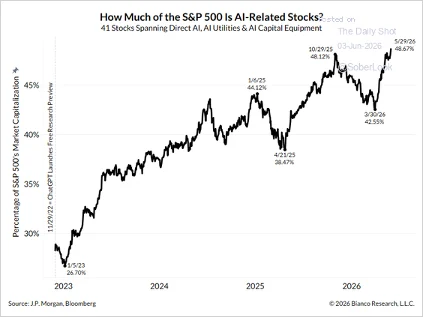
Source: @biancoresearch Read full article
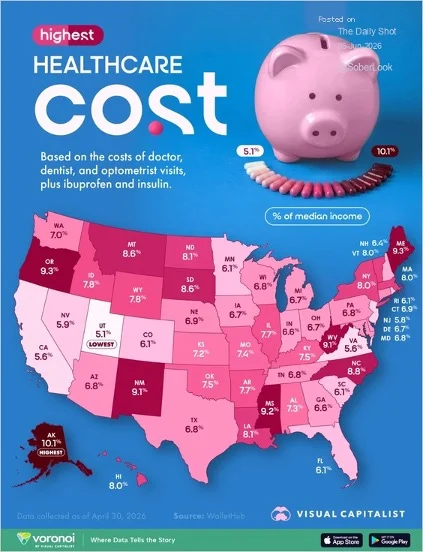
This map shows health care costs as a share of income by state.
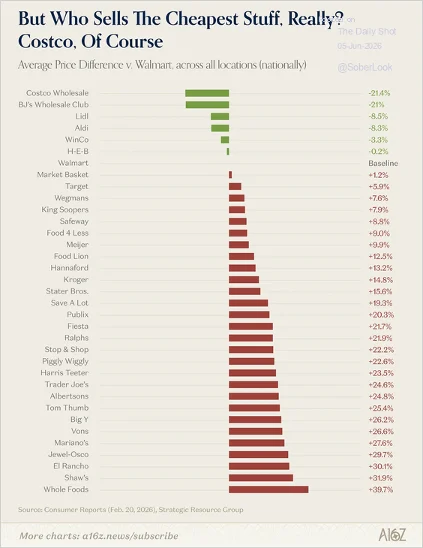
Costco remains the leader in low prices.
The Fed
The Fed’s Beige Book reported that overall economic activity increased at a “slight to moderate pace” in 10 of 12 districts and that employment remained in a “low-hire, low-fire” environment, while inflation pressures intensified. Our Beige Book diffusion indicator rose to the highest level since early 2025.
A Boston Fed study finds that while a 33% real oil price shock would lift PCE inflation by about 1.5 percentage points over the following year, the US economy is far less vulnerable to employment losses than in the 1970s, because lower oil dependence and increased domestic production help offset the shock’s labor market impact.
Great Quotes
“In the middle of every difficulty lies opportunity.”
— Albert Einstein
Picture of the Week
Blasket Islands in Ireland

All content is the opinion of Brian Decker