

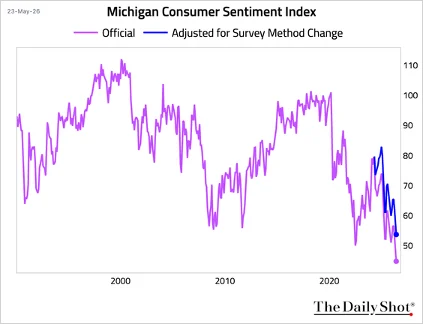
This week’s data gave a mixed read on the economy and markets. The University of Michigan consumer sentiment index was revised down to a record low, even after adjusting for the survey’s shift from phone to online responses, while the Richmond Fed manufacturing index surged well above consensus on stronger production, new orders, and employment. In the stock market, concentration reached a new high, with the top 10 holdings making up a record share of the S&P 500 and Micron becoming the 12th US company to cross $1 trillion in market value. And after the recent move in rates, the 10-year Treasury yield climbed to 4.50%, its highest in nearly a year, as the market’s rate-cut expectations gave way to talk of a possible hike. Below is a closer look at the numbers behind each of these.
US Economy
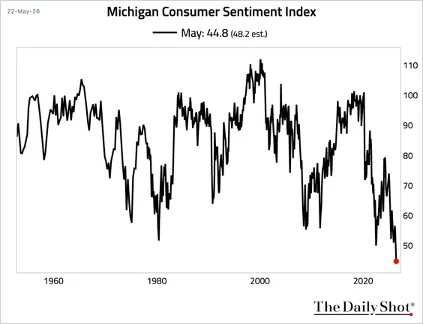
The University of Michigan consumer sentiment index was revised downward to a new record low.

Source: @economics Read full article
Even adjusted for the impact of transitioning from phone-based to online surveys, the series remains depressed.
Underlying inflation is rising. The Richmond Fed Manufacturing Index surged, well above consensus. The strength was broad-based, driven by a jump in production back to expansionary territory, further acceleration in new orders, and an improvement in employment.
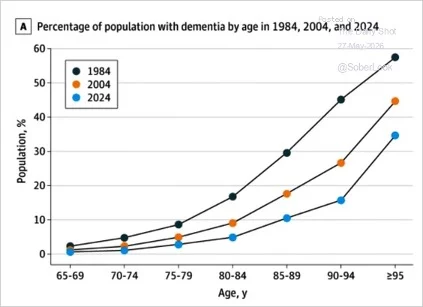
The odds of having dementia at age 85 were close to one in three in the 1980s; now they are one in 10.
Source: @BadreNicolas Read full article
US Stock Market
The top-heavy stock market has been getting even top-heavier. This chart shows the percentage of the S&P 500’s value represented by the top 10 companies. It surpassed the 1990s peak back in 2021; now it’s higher still.
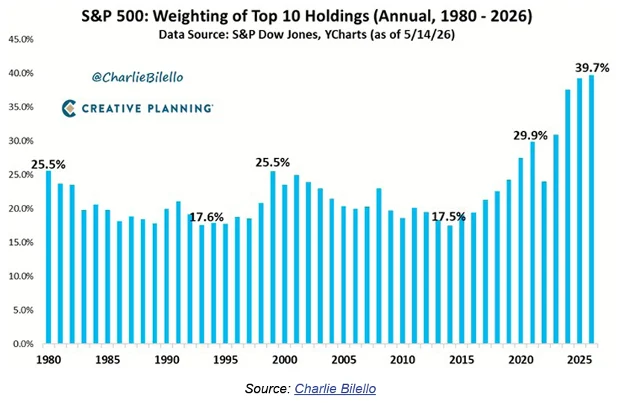
This is partly a function of the index’s capitalization weighting scheme, which directs more money into the largest stocks. The big naturally get bigger. But it’s also related to a more general concentration of market power in a handful of companies with limited competition – or sometimes no competition.
Micron became the 12th US company to surpass a $1 trillion market capitalization—and the fastest ever to rise from $500 billion to $1 trillion, reaching the milestone in just 48 trading days—fueled by investor enthusiasm for AI-driven memory-chip demand.
The Fed
The 10-year yield went from 3.94% the day before the war started to 4.50% at the time of his presentation. Up 54 basis points, the highest in nearly a year.
On March 1st (the day the war started), markets were pricing in 2.5 rate cuts for 2026. Today, markets are pricing in a 40% chance of a rate hike before year-end. Cuts are gone. Hikes are now in the equation.
Great Quotes
“Going to war without France is like going hunting without an accordion.” —Gen. Norman Schwarzkopf (1934-2012)
Picture of the Week
Grand Canyon

All content is the opinion of Brian Decker