


This week’s market roundup walks through Anthropic’s IPO filing, including revenue, operating profit, computing costs, and spending commitments. It also covers the Federal Reserve’s decision to hold rates at 3.75% to 4%, third-quarter GDP growth of 3.4%, record upbeat earnings guidance from S&P 500 companies, hyperscaler free cash flow forecasts, and how data center water use compares with farms and golf courses.
US Economy
Modern data centers reportedly use significantly less water than California almond orchards or golf courses.
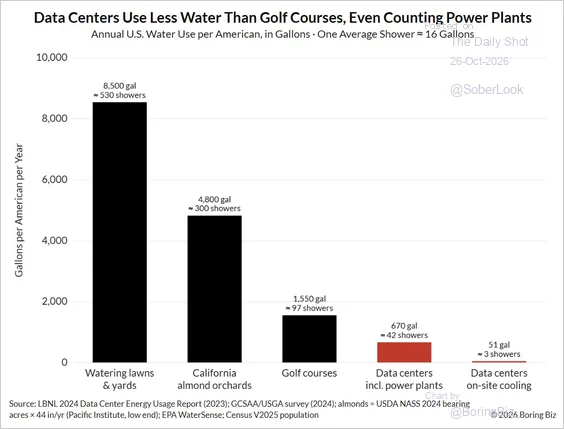
Annual water use per American by category, including data centers. Chart: Boring Biz.
Source: @BoringBiz_
The Dallas Fed manufacturing survey showed that output growth decelerated in October. The new orders index also fell sharply.
Employment moderated. Input price pressures rose further.
Durable goods orders rose more than expected, driven largely by a rebound in volatile transportation equipment orders. Private payroll additions slowed further in the four weeks ending on October 10, according to ADP. Same-store retail sales growth picked up slightly, according to the Johnson Redbook index. The Conference Board consumer confidence index rebounded, with recoveries in both expectations and current conditions. Inflation expectations declined. Consumers’ perceptions of labor market conditions improved, with the gap between those reporting jobs as hard to get and those reporting them as plentiful narrowing. The unemployment rate has been below 5% for five years, among the longest such stretches on record.
The FOMC held the target range steady at 3.75%–4%, in line with consensus. Governor Lisa Cook and Cleveland Fed President Beth Hammack dissented in favor of a 25-basis-point hike. The FOMC reiterated that inflation “remains elevated” and emphasized the need for additional data to guide monetary policy, while upgrading its assessment of economic activity from “solid” to “strong.” The yield curve steepened. The dollar weakened.
Rates futures slightly reduced the probability of a 25-basis-point rate hike in December, from 90% to 85%. Oxford Economics expects two more hikes in the cycle. Nomura is penciling in just one more hike in December. Q3 GDP expanded at a robust 3.4% annualized rate, above the 3.2% consensus estimate, driven by strong consumer spending and business investment, while inventories provided an additional boost. Net trade, in contrast, exerted a meaningful drag. Stripping out government spending, net trade, and inventories, real final sales to private domestic purchasers grew at the fastest pace since the pandemic recovery. Looking beyond Q3, the Atlanta Fed’s initial Q4 GDPNow reading is 3.2%.
The inflation that began in 2021-2022 isn’t “mean reverting” in the way past episodes did. Demographic factors reduce the economy’s ability to absorb more money without chronic inflation. With workforce growth heavily dependent on immigration, small changes have large long-term effects. While some believe advances in AI and computing will enhance productivity, most employment growth is now in labor-intensive sectors like health care where productivity gains are harder to achieve. A large government footprint, a service-heavy economy and rising federal interest costs all work against faster productivity growth. Higher foreign yields can divert funds from US Treasuries, reinforcing upward pressure on borrowing costs.
while temporary factors may lower inflation at times, the risks will remain until money growth aligns with potential output, Fed policy and velocity. Longer yields may keep rising.
US household net worth leads the world at $175 trillion, accounting for roughly 30% of the global total.
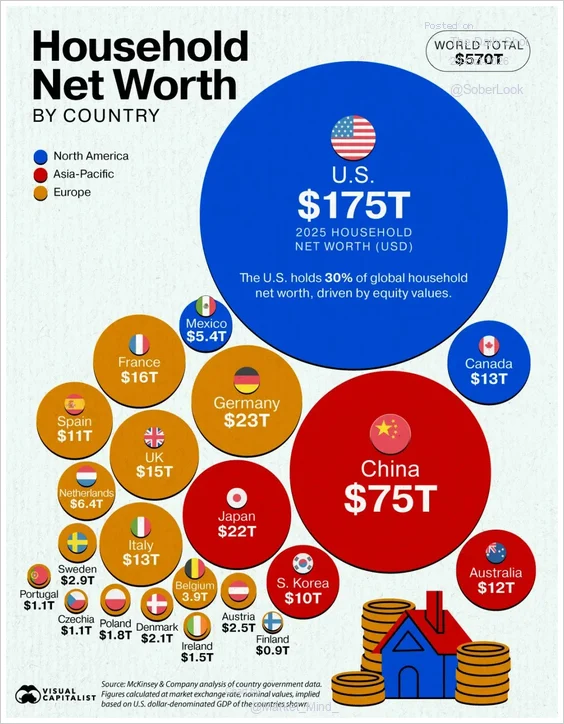
Household net worth by country, 2025. Source: Visual Capitalist, McKinsey & Company.
This visualization shows office space demand for selected markets.
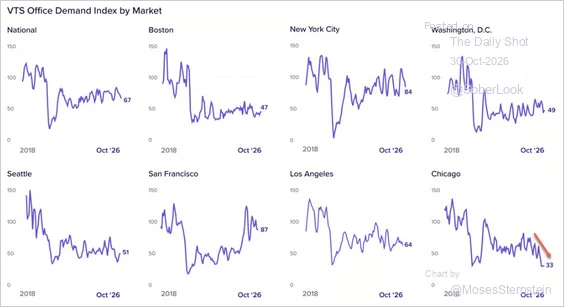
Office space demand by market. Source: VTS.
US Stock Market
A record number of S&P 500 companies have issued third-quarter earnings guidance above consensus estimates.
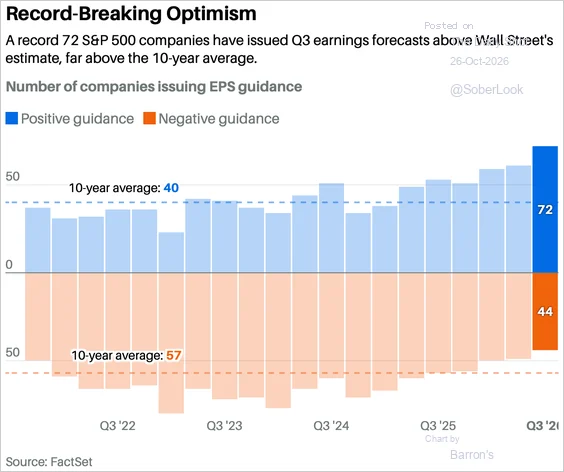
S&P 500 companies issuing positive and negative EPS guidance. Source: FactSet via Barron’s.
Here’s a look at selected hyperscaler free cash flow forecasts for 2026 and 2027.
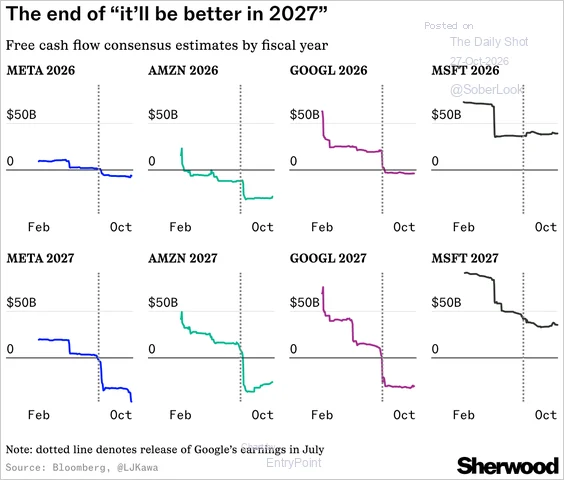
Hyperscaler free cash flow consensus estimates by fiscal year. Source: Bloomberg via Sherwood.
Consensus EPS forecasts for Tesla have been trending down over the past few years, ut these forecasts do not seem to matter for the company’s share price.
Semiconductor market breadth has deteriorated sharply: nearly every Philadelphia Semiconductor Index constituent has declined since June following broad-based gains in the first half. These companies have the largest cash piles among US-listed companies.
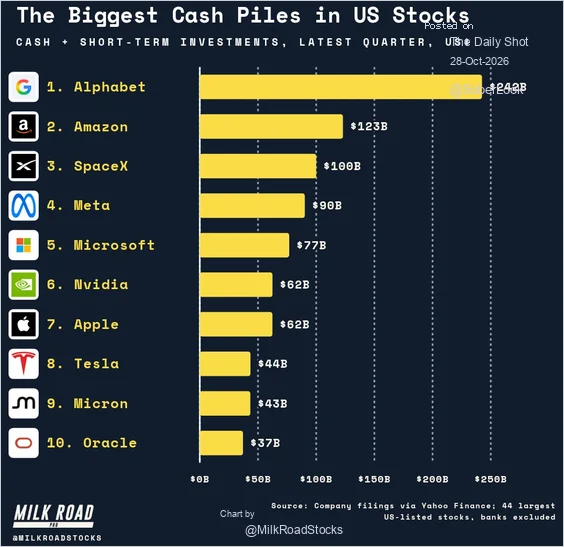
Largest cash piles among US-listed stocks. Chart: Milk Road.
Boring stocks have performed well this month.
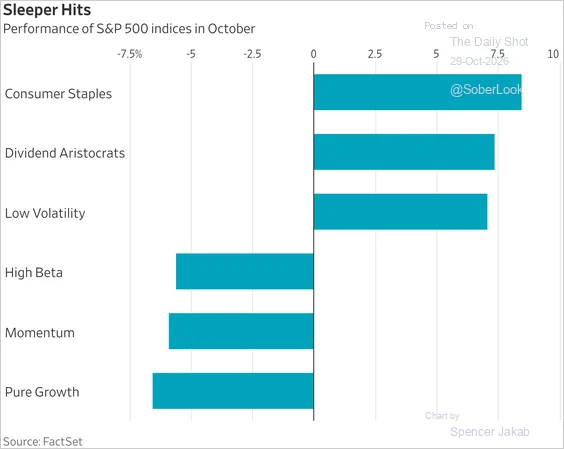
S&P 500 style indexes in October. Source: FactSet.
Technology and communication services are expected to account for half of S&P 500 earnings growth this year, leaving investors heavily reliant on the AI trade.
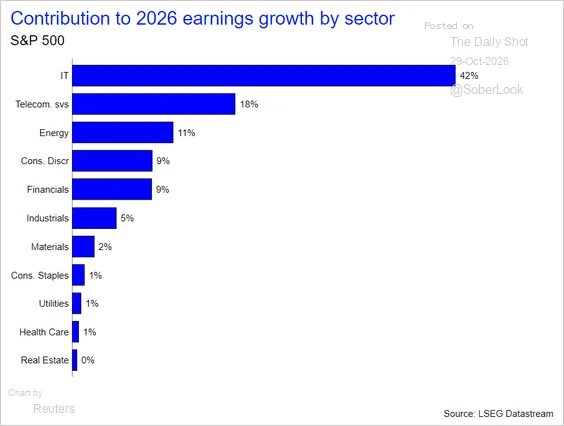
Contribution to 2026 S&P 500 earnings growth by sector. Source: LSEG Datastream via Reuters.
Silver prices continued to decline.
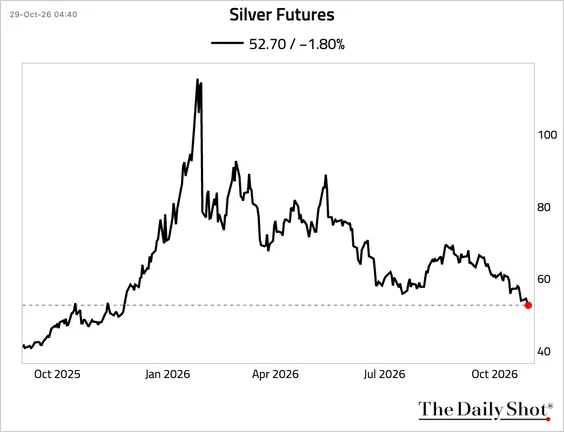
Silver futures. Source: The Daily Shot.
Stocks now account for more than 30% of total US household assets, versus around 25% for real estate. Analysts continue to raise EPS forecasts for the rest of 2026.
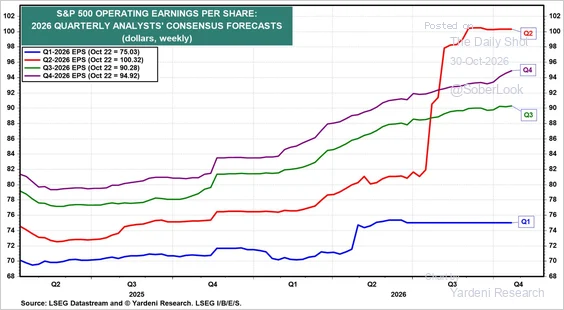
S&P 500 2026 quarterly EPS consensus forecasts. Source: LSEG, Yardeni Research.
Anthropic IPO
Anthropic PBC filed for its long-awaited IPO and plans to list on Nasdaq under the ticker ANT. Consolidated statements of operations for the first halves of 2025 and 2026:
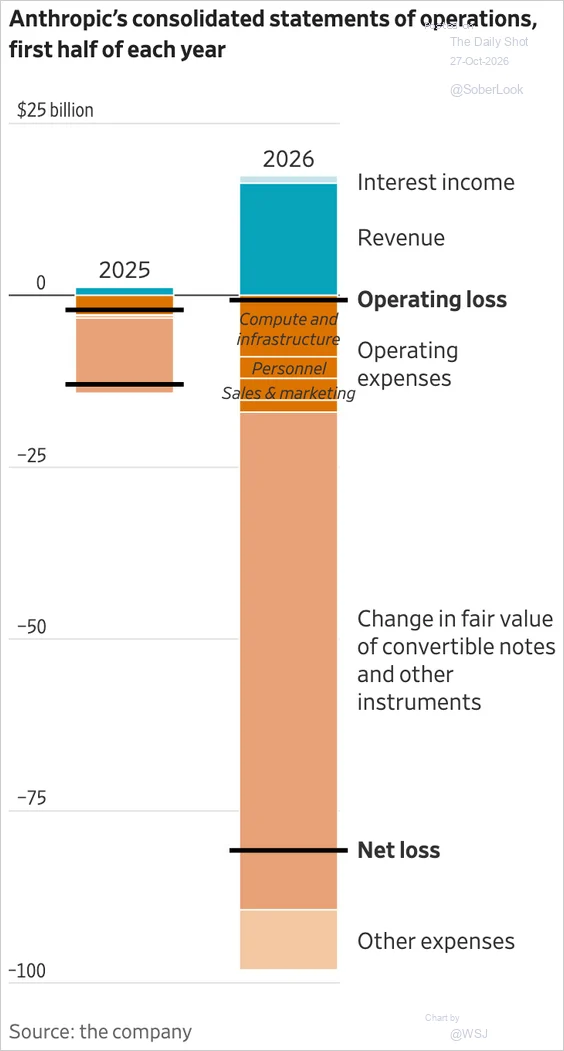
Anthropic’s statements of operations, first half of 2025 and 2026. Source: the company, via WSJ.
Revenue by quarter:
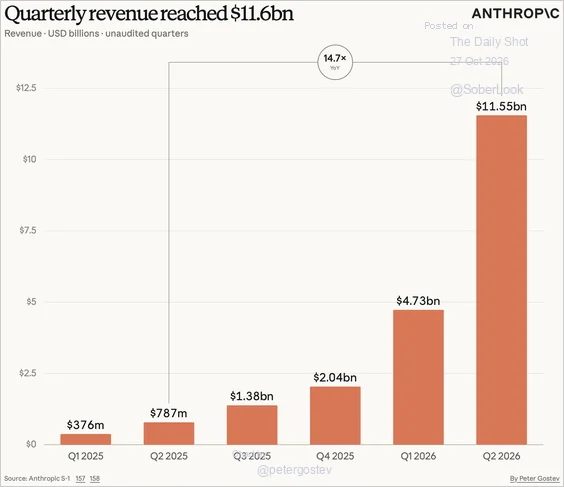
Anthropic revenue by quarter. Source: Anthropic S-1.
Operating profit by quarter:
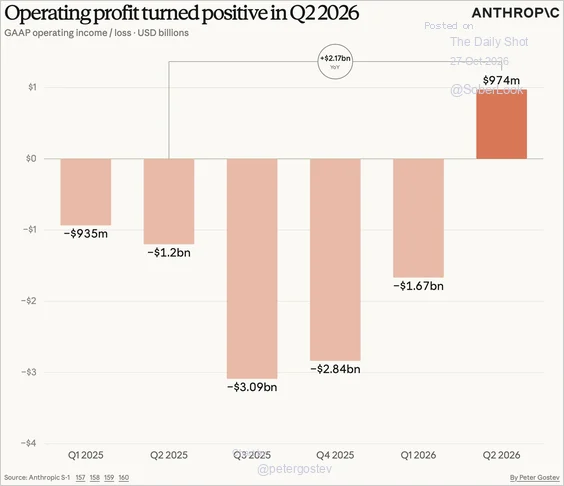
Anthropic operating income or loss by quarter. Source: Anthropic S-1.
Compute and infrastructure costs:
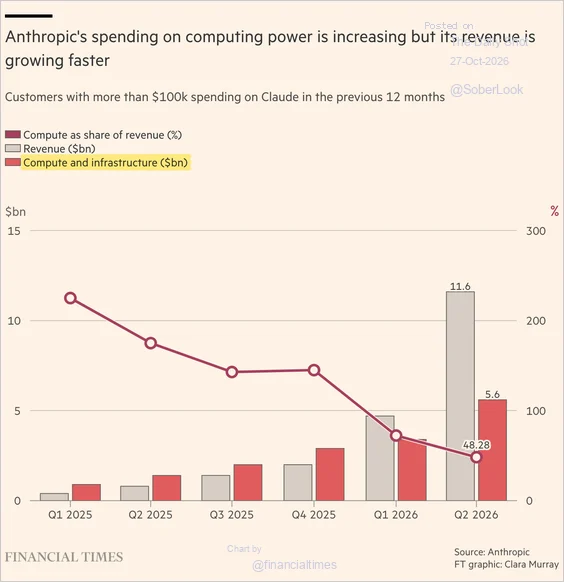
Anthropic compute costs compared with revenue. Source: Anthropic, via Financial Times.
Number of customers by spending bucket:
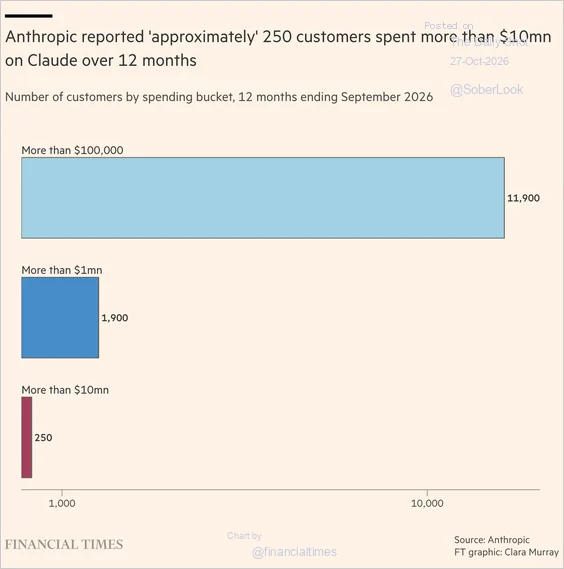
Anthropic customers by spending bucket, 12 months ending September 2026. Source: Anthropic, via Financial Times.
Computing infrastructure spending commitments:
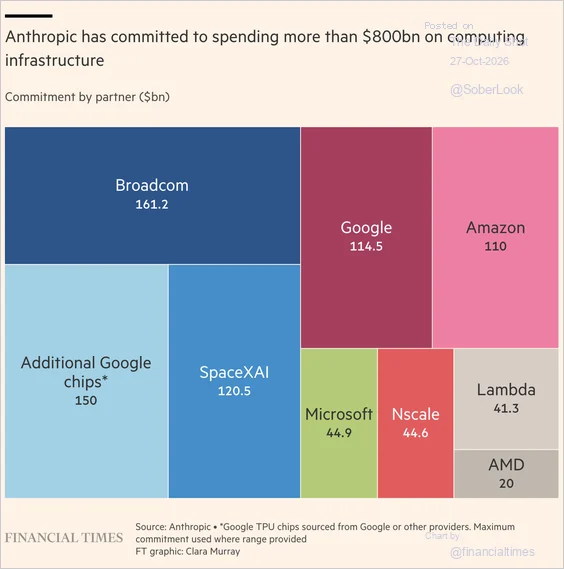
Anthropic computing infrastructure commitments by partner. Source: Anthropic, via Financial Times.
Anthropic’s IPO filing contains an unusually high proportion of language associated with negativity and financial constraints compared with other IPO prospectuses. The 20 largest public offerings since 2010 experienced an average drawdown of 60% in their first 12 months. Will Anthropic join this list?
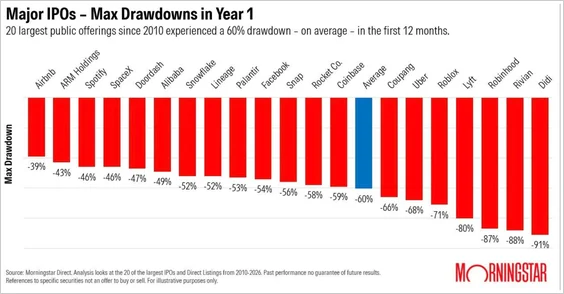
Maximum first-year drawdowns of major IPOs since 2010. Source: Morningstar.
Source: Morningstar via @ReneSellmann
Anthropic has almost as much cash as Amazon, Microsoft, and Apple combined.
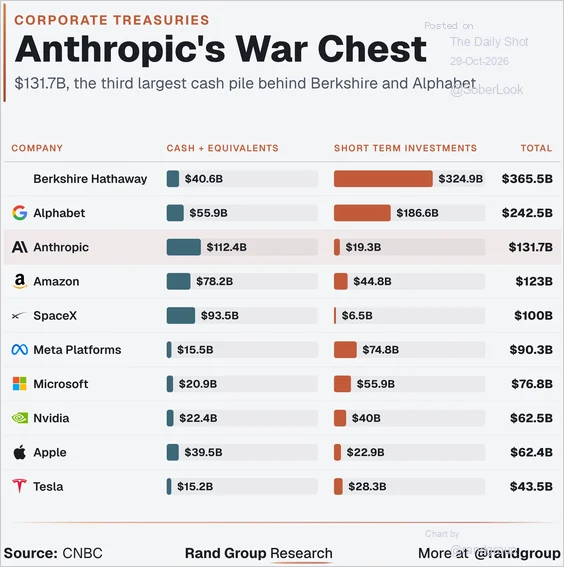
Largest corporate cash piles, including Anthropic. Source: CNBC, Rand Group Research.
Great Quotes
“There are more things likely to frighten us than there are to crush us; we suffer more often in imagination than in reality .”
Seneca
Picture of the Week
Autumn Lake

All content is the opinion of Brian Decker









Leave A Comment