


This week’s market and economic roundup covers the AI stock selloff, the fastest in more than five years, and Apple’s return to the top of the S&P 500 for the first time in about 18 months. It also covers Nvidia’s $1.2 trillion drop in market value, a stronger-than-expected jobs report, existing home sales at their lowest level since 2010, data center ballot measures in the midterms, record share buybacks, and a hotter October CPI report that has Fed officials discussing a larger December rate hike.
US Economy
The Atlanta Fed’s GDPNow estimate for Q4 growth edged up to 3.5% from 3.4% on November 4. Underlying details are also robust. Real final sales to domestic purchasers, which remove volatile inventories and net trade, are solid at 3.4%. Excluding government spending, real final sales to private domestic purchasers are forecast at 3.8%.
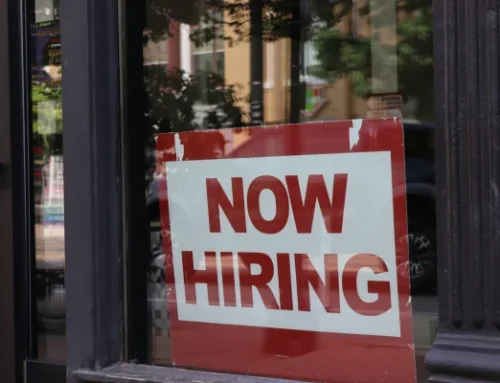
Nonfarm payroll gains accelerated sharply to 165,000, well above consensus, with private payrolls accounting for the bulk of the increase. Data for the previous two months were also revised higher by 84,000. The three-month average suggests that hiring momentum is improving. Hiring was bolstered by strength in professional and business services as well as health care, alongside favorable near-term demand in AI-linked categories such as nonresidential data center construction. Manufacturing employment growth is at a multiyear high. The unemployment rate edged down by three basis points to 4.14%, reflecting a 463,000 increase in household employment and a slightly smaller 421,000 increase in the size of the labor force. The underemployment rate (U-6) rose 30 bps to 7.9%, largely reflecting an increase in marginally attached workers.
Data centers lost 46 of 47 ballot measures in the midterms.
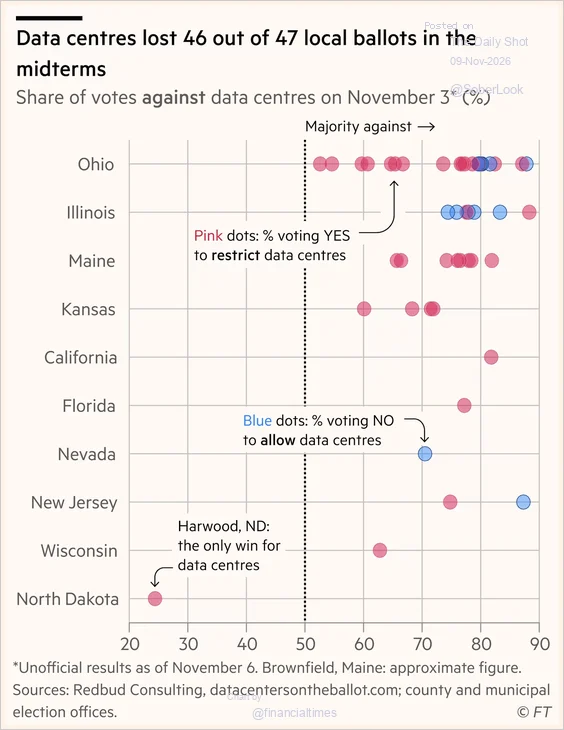
Data centers lost 46 of 47 local ballot measures in the midterms. Source: Financial Times.
Here’s a ranking of America’s healthiest cities.
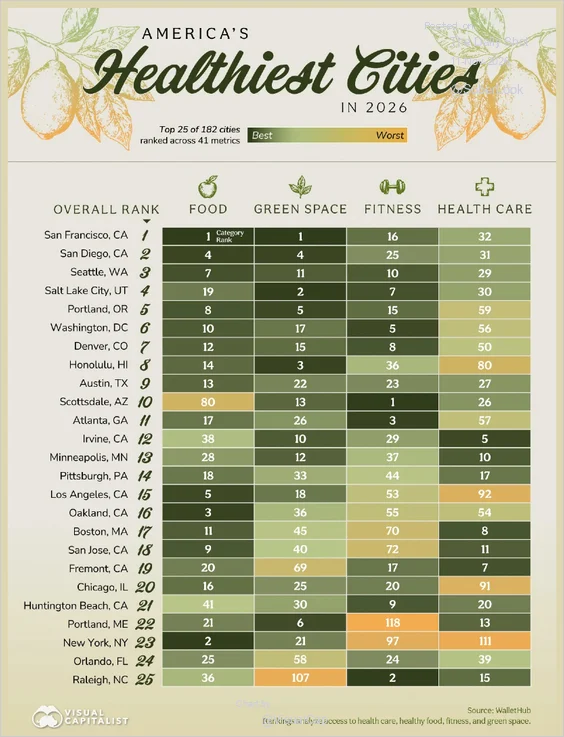
America’s healthiest cities in 2026. Source: Visual Capitalist, WalletHub.
Redbook’s same-store sales data point to robust spending. Economic data have surprised to the upside, particularly for hard data. Oxford Economics sees 2027 growth remaining heavily dependent on the AI build-out, following substantial contributions from AI investment and the equity wealth effect in 2025–26.
Initial jobless claims rose more than expected, driven partly by a spike in Missouri that may prove temporary. Leading indicators still point to jobless claims remaining contained. WARN advance layoff notices partially reversed the previous month’s jump, while Challenger layoff announcements remained subdued.
Existing home sales fell to their lowest level since August 2010 as high mortgage rates continued to weigh on affordability. Unsold inventory expanded, potentially putting further downward pressure on home prices. The median home price declined 0.4% in October but rose 0.4% year over year, with the Northeast and Midwest continuing to outperform the South and West, although regional disparities have narrowed.
US Stock Market
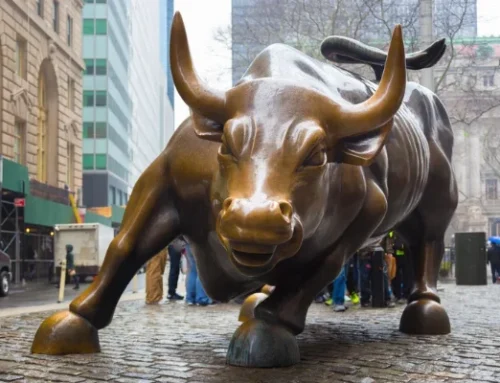
AI-related stocks were sold at the fastest pace in more than five years.
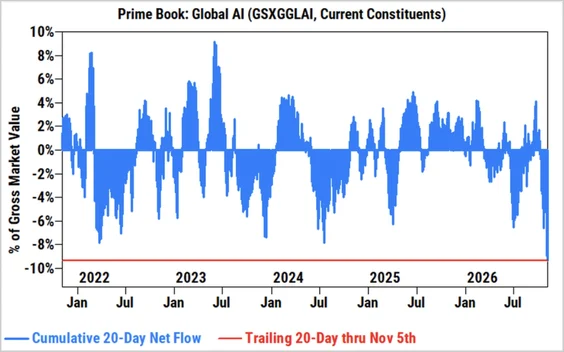
Net selling in global AI stocks through Nov. 5, 2026.
Semiconductor stocks are trading at their lowest relative valuation versus the broader market since 2018. Apple has outperformed the other Magnificent Seven companies and the Nasdaq this year.
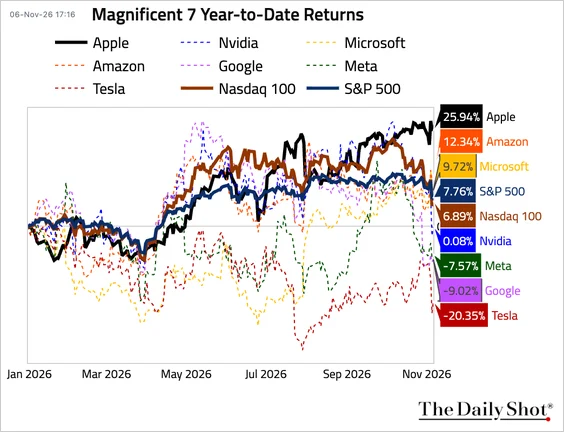
Magnificent Seven year-to-date returns as of Nov. 6, 2026. Source: The Daily Shot.
Unlike its Big Tech peers, Apple has avoided a comparable surge in AI CapEx infrastructure spending. Analysts bumped up Q3 EPS estimates but lowered Q4 forecasts. Earnings growth expectations have plateaued across both short- and long-term horizons.
The AI stock selloff has prompted some prospective Anthropic IPO investors to discuss valuations of $1.2 trillion–$1.3 trillion, with estimates as low as $1.1 trillion, well below earlier expectations of up to $2 trillion.
Market-driven investment is expected to avert shortages in nine of 10 critical minerals through 2050, but copper remains a key exception, with projected demand exceeding supply beginning in 2028.
Russell 3000 companies have authorized a record $1.5 trillion in share buybacks this year.
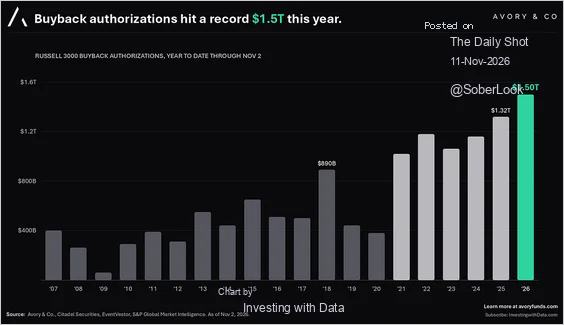
Buyback authorizations hit a record $1.5 trillion this year. Source: Avory & Co.
Nvidia has shed $1.2 trillion in market capitalization over the past 10 days.
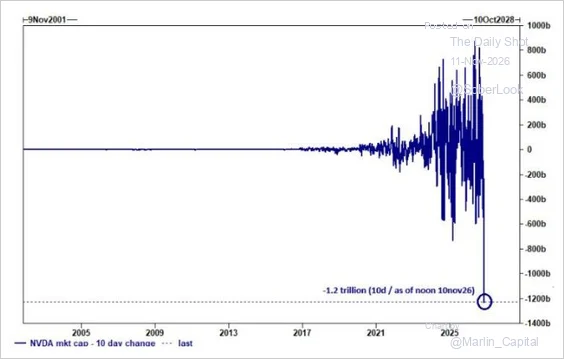
Nvidia shed $1.2 trillion in market value over 10 days.
A study of 30 large-cap companies over the past decade found that CEO ousters typically follow sharp stock price declines and are often accompanied by further losses.
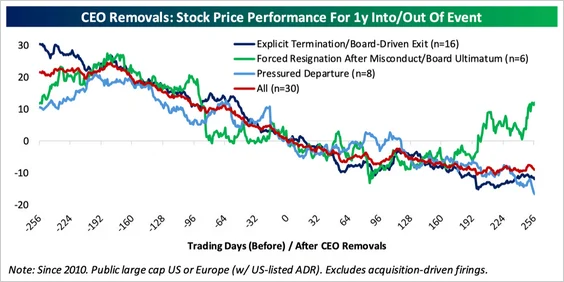
Stock performance before and after CEO removals. Source: Bespoke.
Source: Bespoke via Daily Chartbook
Apple has reclaimed its position as the S&P 500’s largest constituent for the first time in roughly 18 months. The charts below show the largest S&P 500 companies over time.
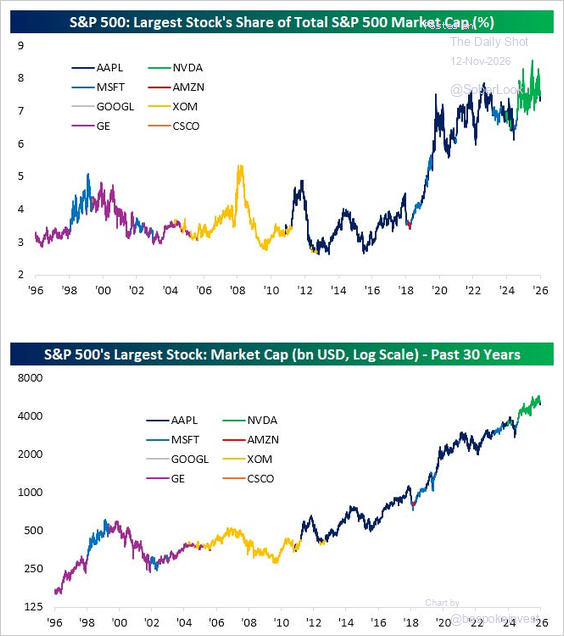
The largest stock in the S&P 500 over the past 30 years, by share of the index and by market value. Source: Bespoke Investment Group via The Daily Shot.
Source: @bespokeinvest Read full article
The Fed
In news that was a surprise to no one (except some folks at the Federal Reserve) last Tuesday, the U.S. Bureau of Labor Statistics (“BLS”) said the consumer price index (“CPI”) rose 0.4% in October… above the 0.3% economists expected. Food prices rose 0.5%, energy 0.7%, and gasoline 1%. Core CPI, which strips out food and energy, rose 0.3% versus a 0.2% forecast. That’s the third straight month of 0.3% core readings, which works out to a 3.6% annualized pace.
In short, the pace of inflation is rising well above the Federal Reserve’s 2% target, as it has been for months now. Meantime, real average earnings for private-sector workers were flat, meaning paychecks didn’t keep up with price increases last month. Inflation… It’s hot. Again.
Fed Governor Christopher Waller laid out the scenario just before the report was released last Tuesday, in prepared remarks from London.
Waller said he was already leaning toward a quarter-point hike at the Fed’s December 8-9 meeting… but if core CPI came in around 0.3% or higher, “I believe a 50-basis point hike in the policy rate should be considered…”
Well, it did.
Last Tuesday, the 10-year Treasury yield touched 5% for the first time in two weeks, and the 2-year yield – more sensitive to Fed policy – jumped 17 basis points to 4.75%, implying market expectations for an additional rate hike that weren’t present the day before. Federal-funds futures traders now see a December hike as a lock. The odds of a half-point move jumped to about 10% from 0% the day before, according to the CME Group’s FedWatch Tool.
Absent a 50-basis-point hike next month, sustained inflation readings like this could mean a quicker schedule of smaller rate increases down the road.
At a different event, Dallas Fed President Lorie Logan, a voting member of the Fed’s policy committee this year, said she thinks the Fed’s benchmark rate is 50 basis points below a “modestly restrictive level.”
She said she’d prefer to get there gradually, in quarter-point steps, but that “it may be possible to move more rapidly this winter.”
Between Waller and Logan, the debate inside the Fed is no longer whether to hike. It’s how much or how quickly.
Headline inflation rose by 0.4% month over month in October, while core inflation increased by 0.3%, both hotter than expected. The BLS could not publish year-over-year inflation readings for most categories because of the October 2025 government shutdown. Our estimates suggest annual headline inflation exceeded 4%.
Great Quotes
“The art of taxation consists in so plucking the goose as to obtain the largest possible amount of feathers with the smallest possible amount of hissing.”
– Attributed to Jean-Baptiste Colbert
Picture of the Week
Christmas market in Vienna

Vienna’s Christmas market in front of City Hall opened for the season on Nov. 13. Its stalls and lights run through the holidays.
All content is the opinion of Brian Decker








Leave A Comment