


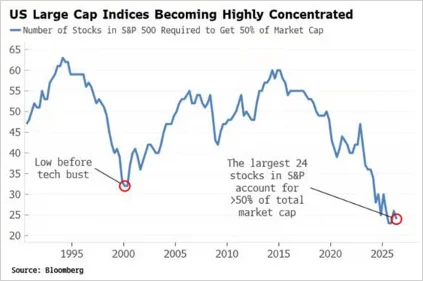
Just 24 stocks now account for half the total market capitalization of the S&P 500. That is a tighter concentration than at the peak of the dot-com bubble. The rest of the week’s data covered a wide range. Industrial production barely grew in June and manufacturing output stalled on weakness in durable goods, while initial jobless claims fell to their lowest level since 1969. Housing starts rebounded on multifamily construction even as building permits declined for a second straight month. On the inflation side, consumers trimmed their near-term expectations while import prices for computer peripherals and parts rose 41.6% from a year ago.
US Economy
Industrial production barely grew in June. Manufacturing output stalled completely due to weakness in durable goods production.
Utilities output eked out a gain. The soft month-over-month growth rate, however, comes on the heels of a string of strong readings earlier in the year, which pushed the levels of industrial production to multiyear highs. While the recovery in manufacturing that got underway in 2025 was initially concentrated in a few relatively advanced industries—mostly computer and electronics equipment and aerospace—the upturn has become broader in recent months. Capacity utilization held steady.
Housing starts rebounded sharply,driven entirely by volatile multifamily starts, while the core single-family segment edged down. Housing units under construction, a more important driver of residential investment, have been broadly stable. Building permits declined for a second consecutive month.
The University of Michigan Consumer Sentiment Index rebounded sharply, topping expectations. The increase was driven by an improvement in both the current conditions component and the expectations component.
Mortgage applications rebounded even as the 30-year fixed mortgage rate ticked up.
Initial jobless claims fell sharply to the lowest level since 1969. Continuing claims edged down and remained lower than in the same period last year. Leading indicators—such as the Challenger job cuts series and WARN advance layoff notices—point to little change in layoff trends in the near term. The Chicago Fed National Activity Index was roughly flat in June, consistent with the economy expanding at trend growth.
US Stock Market
The early Q2 earnings season has topped expectations, with 88% of reporting S&P 500 companies beating EPS estimates. . Market breadth continues to strengthen, with roughly two-thirds of large-, mid-, and small-cap US stocks now trading above their 200-day moving averages—the highest participation levels since late 2024.
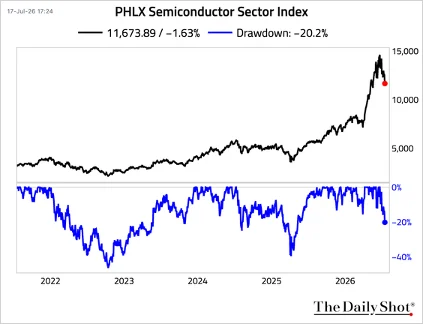
Chip stocks fell into bear-market territory.
Apple briefly overtook Nvidia as the world’s most valuable company by market capitalization. Meanwhile, SpaceX’s market capitalization has fallen by more than $1 trillion from its peak.
SpaceX bonds are topping the leaderboard for the worst performing BBB USD corporate bonds with a face value of at least $1 billion, since their inclusion in ICE BofA indices at the end of June.
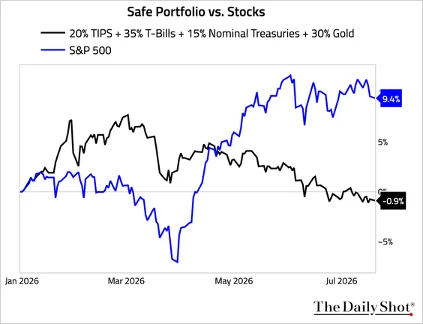
The “Safe Portfolio” is down year to date.
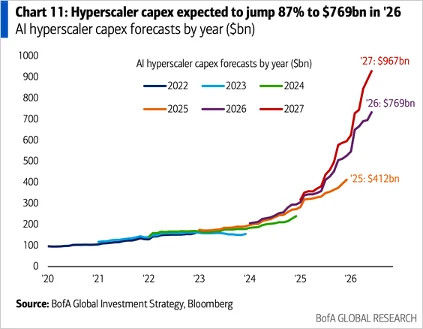
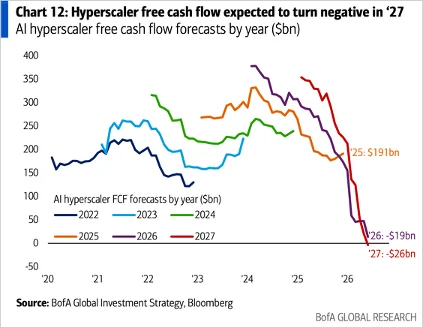
Hyperscaler capex is expected to jump 87% in 2026 and another 26% in 2027.
Source: Michael Hartnett, BofA Global Research
However, free cash flows are forecast to turn negative in 2027.
Source: Michael Hartnett, BofA Global Research
Just 24 stocks now account for 50% of the index’s total market capitalization, marking an even greater concentration than at the peak of the dot-com bubble.
Source: Simon White via Daily Chartbook
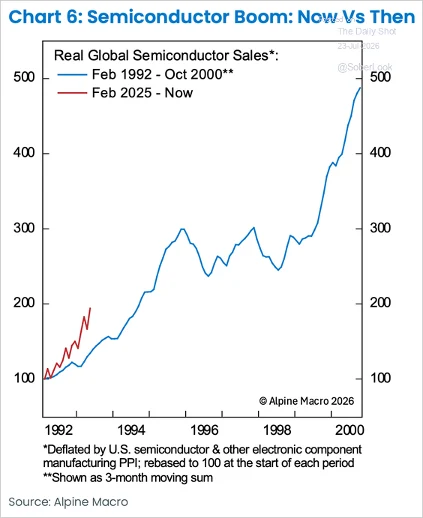
Real global semiconductor sales have risen 80% since 2025, well below the fivefold increase during the internet boom of the 1990s, suggesting the current semiconductor expansion may still have substantial room to run.
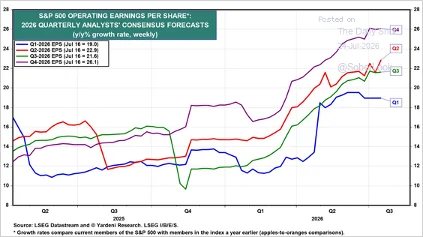
Analysts raised EPS forecasts for the rest of the year.
Source: Yardeni Research
The Fed
Consumers’ median inflation expectations over the next year eased, while longer-term expectations held steady. Import prices unexpectedly rose month over month in June, driven by nonfuel components, while export prices fell more than anticipated. Import prices for computer peripherals and parts rose 2.3% month over month and 41.6% year over year, pointing to further upward pressure on core inflation from electronics prices.
More than half of tariff-sensitive core goods CPI components posted price declines in June, based on Nomura’s calculation.
Business inflation expectations for the coming year decreased to 2.2%, according to the Atlanta Fed’s latest survey.
Great Quotes
“You can avoid reality, but you cannot avoid the consequences of ignoring reality.”
– Ayn Rand
Picture of the Week
Switzerland

All content is the opinion of Brian Decker












Leave A Comment