


The federal deficit reached $1.99 trillion in fiscal year 2026, the largest since 2021. This week’s roundup of the US economy and stock market covers third-quarter GDP tracking, September industrial production, how much the maximum Social Security benefit has grown after inflation since 1990, lifetime Medicare benefits for a retiring couple, homebuilder sentiment at its lowest in more than 14 years, Big Tech’s AI spending compared with past investment booms, earnings estimates, and September import prices.
US Economy
The Atlanta Fed’s GDPNow model is now tracking Q3 GDP at 3.5%, down from 3.6% last week. The underlying details are also strong. Real final sales to domestic purchasers, which exclude volatile inventories and net trade, are tracking at a solid 4.5%. Excluding government spending, real final sales to private domestic purchasers are forecast at 4.9%
Industrial production growth accelerated in September, exceeding expectations. The increase was broad-based, driven by modest gains in manufacturing and a surge in utilities output. Consumer goods production continued to contract, although at a slower pace, while business equipment output remained strong. Manufacturing growth remains concentrated in advanced industries, particularly computers, electronics, and aerospace.
Industrial capacity utilization rose.
The deficit reached $1.99 trillion in fiscal year 2026, the largest since 2021. This chart provides an overview of the breakdown in receipts and outlays.
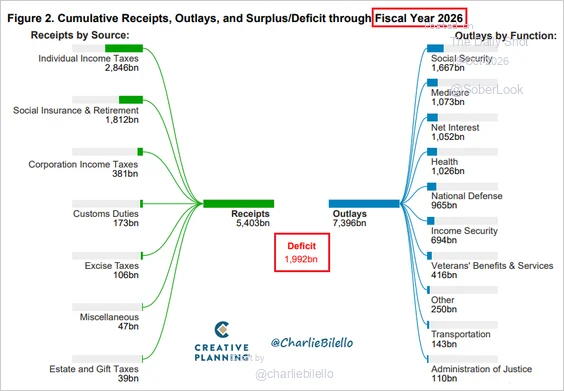
Federal receipts, outlays, and deficit, fiscal year 2026. Source: @charliebilello
Source: @charliebilello
The maximum Social Security retirement benefit for workers claiming at age 70 has risen 86% in real terms since 1990.
A dual-average-earner couple retiring at age 65 in 2025 is projected to receive $722,000 in lifetime Medicare benefits against $225,000 in contributions, both measured in present-value terms.
NAHB homebuilder sentiment slumped to its lowest level in more than 14 years. Both soft data (sentiment surveys) and hard data (such as home sales) are at depressed levels, as affordability continues to deteriorate. Rising mortgage rates could put further downward pressure on homebuilder confidence. A substantially larger share of outstanding mortgages now carries interest rates below prevailing market rates than in 2022. Housing-related stocks have sold off.
Hawaii is the happiest US state in WalletHub’s 2026 rankings.
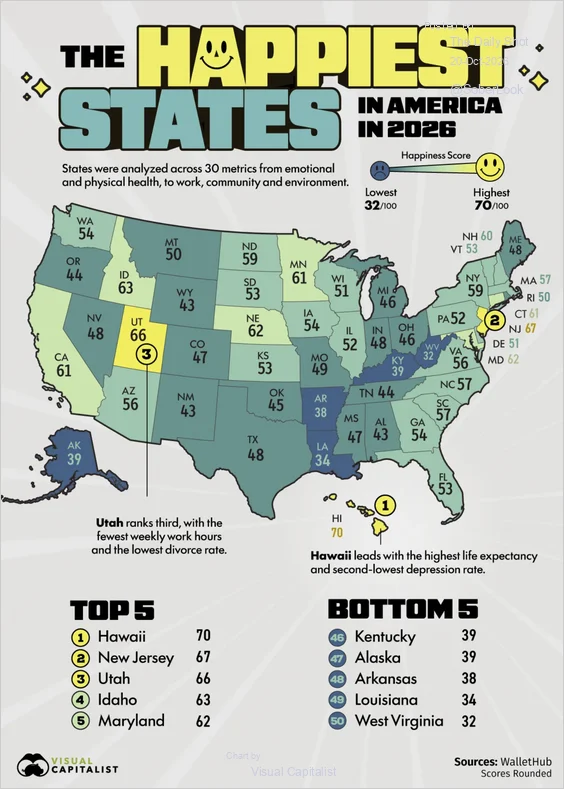
The happiest states in America, 2026. Source: WalletHub via Visual Capitalist
Hyperscaler capex has climbed faster than in any earlier investment boom, including canal mania, the railway boom, the Roaring Twenties, and the dot-com era.
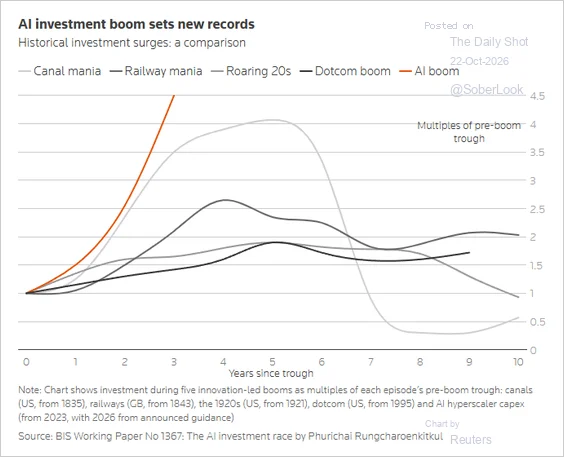
AI investment compared with past investment booms. Source: BIS via Reuters
Source: Reuters Read full article
Amazon plans to hire more than 300,000 workers across seasonal, part-time, and full-time positions for the holiday season, a 20% increase from last year.
US Stock Market
Third-quarter EPS estimates were stable week over week, while fourth-quarter estimates continued to rise. Full-year EPS estimates for both 2026 and 2027 continue to rise. The profit margin expansion in the US has been broad-based.
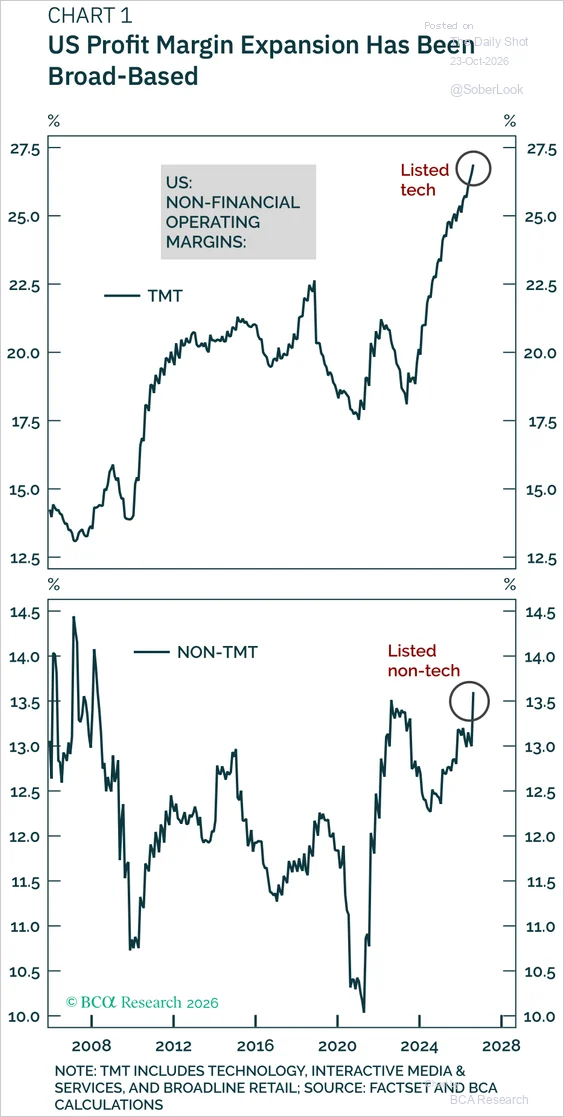
US profit margin expansion has been broad-based. Source: BCA Research
Microsoft is the only major hyperscaler expected to maintain positive free cash flow over the next 12 months.
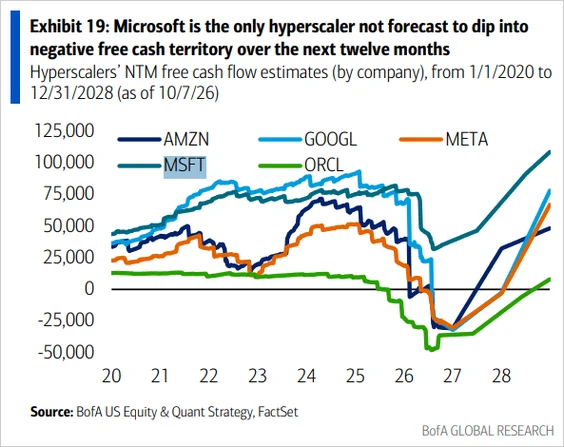
Hyperscaler free cash flow estimates. Source: BofA Global Research
Source: BofA Global Research via @MikeZaccardi
Semiconductor stocks represent just 5% of MSCI ACWI constituents but account for 25% of daily trading volume. All parts of the AI theme have been correcting for roughly five months.
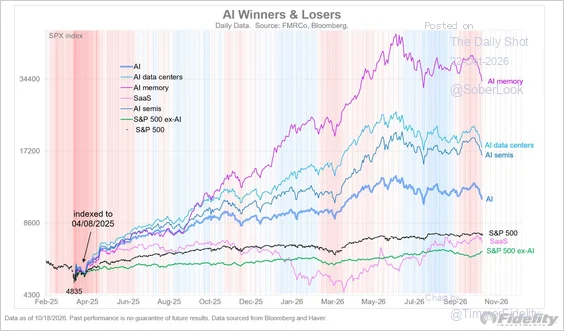
AI winners and losers. Source: Fidelity, Bloomberg
Source: @TimmerFidelity
Anthropic’s first-half revenue surged to $16.3 billion from $1.1 billion a year earlier, although customer concentration remains high, with two customers accounting for roughly 20% of revenue. The company reported an $80.7 billion net loss in the first half of 2026, nearly double its full-year 2025 loss of $42 billion, with $72 billion attributable to accounting charges related to changes in the value of convertible notes and other financing instruments. Anthropic now generates more quarterly revenue than established corporate giants including Intel, Uber, Coca-Cola, and Netflix.
The Fed
Import and export price inflation accelerated in September. Import prices for computer peripherals and parts eased considerably month over month but are still up nearly 50% year over year.
Great Quotes
“If you want to live a happy life, tiel it to a goal, not to a person.” – Albert Einstein
Picture of the Week

Bran Castle in Transylvania, Romania
All content is the opinion of Brian Decker












Leave A Comment