

The Federal Reserve raised the target range for the federal funds rate to 3.75%-4.00% on Wednesday, its first increase since 2023, and the 10-year Treasury yield moved above 5% around the decision. This week’s article covers the manufacturing and housing data, jobless claims, the August inflation report, where the major indexes sit relative to their moving averages, and how economists were positioned ahead of the FOMC.
US Economy
The Philadelphia Fed’s manufacturing index moderated, but the overall reading remained robust. Demand held up, with shipments unchanged, and new orders edging only slightly lower. The employment index, however, eased considerably. Price pressures reaccelerated.
Initial jobless claims declined to 196,000, below consensus. Continuing claims declined, well below prior-year levels. The number of states with initial claims rising over 20% year over year has been trending lower.
Housing activity remained weak in August. Housing starts contracted month over month. The headline weakness was driven by a sharp contraction in multifamily projects, which overshadowed a rebound in single-family construction. Building permits also fell, pointing to continued weakness in the construction pipeline as elevated mortgage rates weigh on affordability. Pending home sales barely rose and the level remained depressed, consistent with uninspiring survey readings.
US Stock Market
The Dow Jones Industrial Average fell below its 100-day moving average.
The Nasdaq Composite slipped below its 100-day moving average.
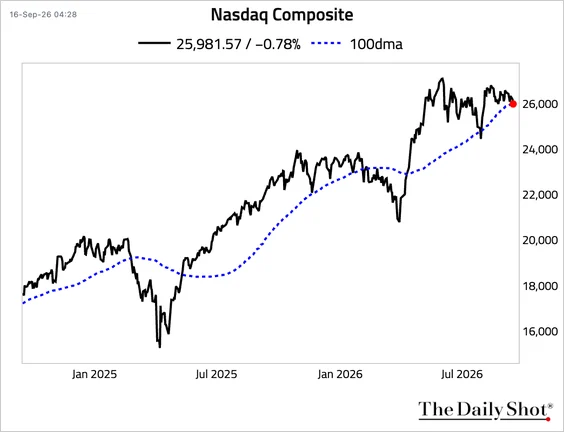
Nasdaq Composite slips below its 100-day moving average. Source: The Daily Shot
The real estate sector fell below its long-term support 200 dma.
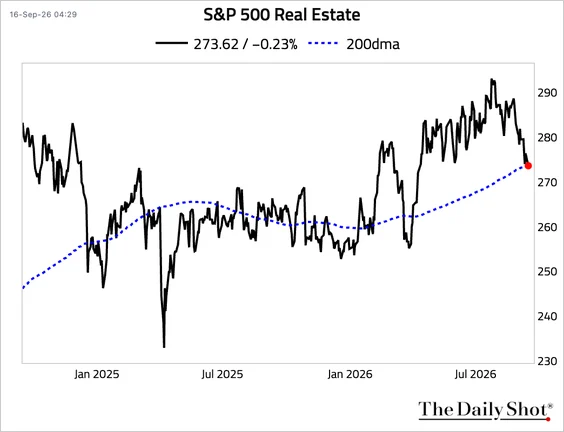
S&P 500 real estate sector falls below its 200-day moving average. Source: The Daily Shot
Analysts continue to raise EPS forecasts for the rest of 2026.
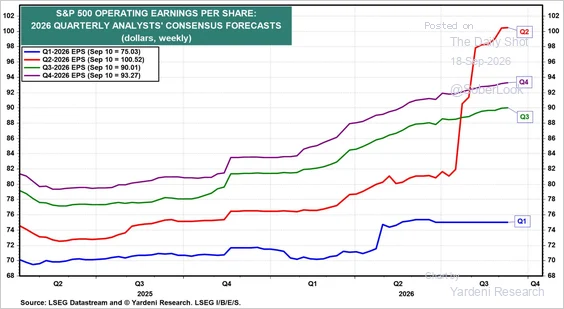
Analysts continue to raise 2026 EPS forecasts. Source: Yardeni Research
Source: Yardeni Research
Growth in forward EPS has been accelerating.
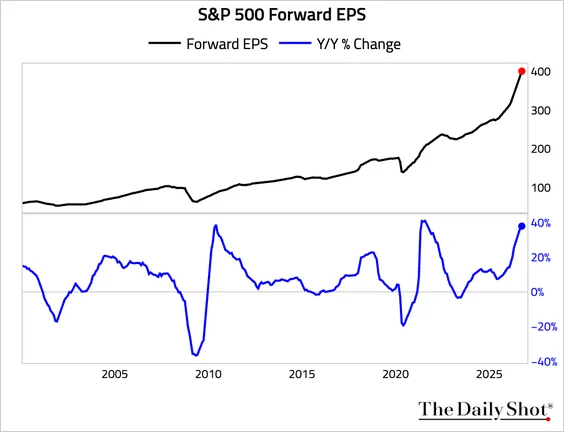
S&P 500 forward EPS and year-over-year growth. Source: The Daily Shot
Long-term earnings-growth expectations have continued to rise even as near-term expectations have eased.
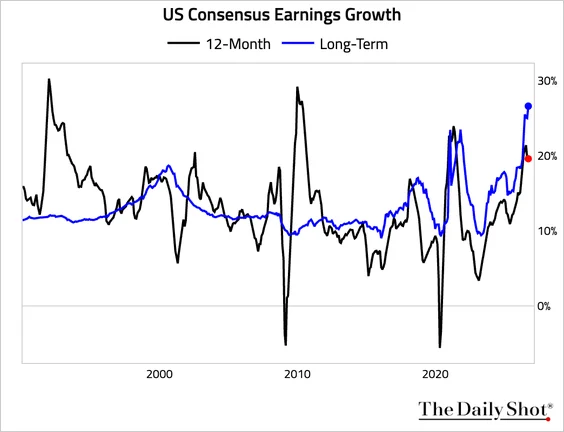
12-month versus long-term consensus earnings growth expectations. Source: The Daily Shot
The Fed
Headline inflation accelerated to 0.4% month over month in August, in line with consensus. However, core inflation rose by 0.3% month over month, hotter than expected. The share of the CPI basket running at over 3% annualized inflation rose, casting doubt on the disinflationary trend. Food inflation picked up, although the increase was modest. Ground beef prices rebounded and stayed above $7 per pound for the fifth consecutive month.
Turning to components of core inflation, core goods prices increased for a second month. The sharp increase in the prices of computers and peripherals, thought to be a one-off, accelerated further in August, driven by AI hardware demand.
Here’s the latest look at economists’ Fed calls ahead of today’s FOMC decision. Not only are central bank watchers overwhelmingly expecting a rate hike today, most of them are also calling for at least a second hike before the end of the year.
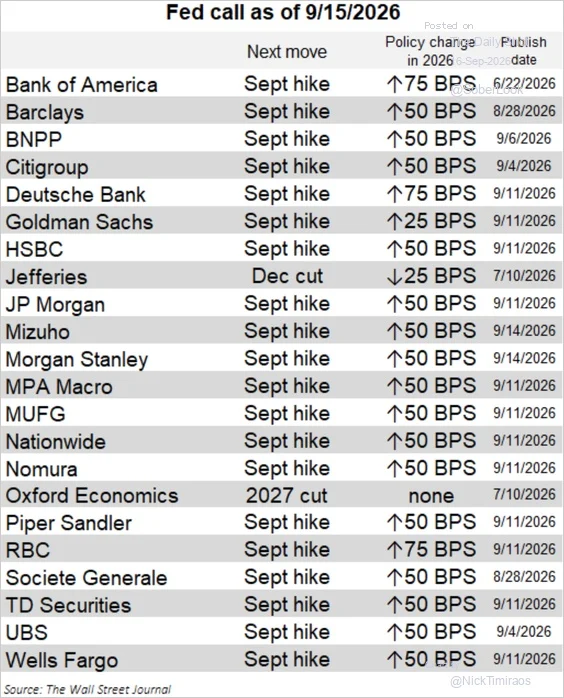
Economists’ Fed calls ahead of the September FOMC meeting. Source: The Wall Street Journal
It happened. The U.S. Federal Reserve on Wednesday raised interest rates by a quarter of a percentage point, marking the first rate hike in more than three years. Investors are still digesting what it will mean for markets, as well as the impact on the average person’s wallet in 2026 and beyond.
Bigger picture: The central bank directly controls short-term rates through the Federal Funds Rate, which sets the cost of overnight borrowing between commercial banks. This in turn impacts the prime rate, or the benchmark interest rate that financial institutions use for many consumer products, such as credit cards, variable personal loans, and home equity lines of credit. It can also impact new or adjustable-rate car loans and mortgages, as well as corporate balance sheets, given that many companies depend heavily on short-term funding like commercial paper for daily operations.
Following the hike, top U.S. lenders, including JPMorgan (JPM), Bank of America (BAC), Citigroup (C), and Wells Fargo (WFC), all raised their prime rate by a quarter point, which increased from 6.75% to 7% as of Thursday. Interestingly, as short-term costs rise, longer-term borrowing costs generally come down. This is because the latter are associated with economic conditions like growth and inflation that can be brought into check by a rising Fed Funds Rate. Investors previously felt that these concerns were not being taken seriously enough, causing the 10-year Treasury yield (US10Y) to spike above the 5.00% level. However, the new message from the central bank sent a signal to Wall Street, along with a closely watched dot plot that showed most Fed officials expecting another rate hike this year.
While FOMC actions can trigger movement in long-term borrowing costs, the yields do not always move in lockstep with policy—barring interventions like QE, twist operations, or yield curve control. Instead, long-term rates rely heavily on supply and demand dynamics that can even occur far beyond America’s borders. Among them are foreign stockpiles of U.S. Treasuries, which just fell to their lowest level in nine months due to drawdowns in France, Canada, China, and Japan. Financing for the AI revolution can also dry up demand, as well as environments where investors seek higher term premiums to compensate for uncertainty. Trump calls for interest rates of 1% or lower
“The surge in capital expenditures is real, and the so-called hyperscalers are out in the market raising funding, and so the competition for capital is real,” Fed Chair Kevin Warsh noted in his press conference. “The situation in hotspots around the world are driving long-term yields. It’s not simply spot prices of energy or spot prices for corn or soybeans or wheat, but it’s the difference between those spot prices and so-called crack spreads, what that means for products that find their way into stores across the country.”
In the latest press conference, Fed Chair Kevin Warsh eliminated follow-up questions, shortened his responses, broadened the range of outlets called on, and cut the total briefing duration to about 30 minutes.
Great Quotes
“I can complain because rose bushes have thorns or rejoice because thorn bushes have roses.”
— Sir John Templeton
Picture of the Week
Lalaria Beach, Greece

All content is the opinion of Brian Decker