

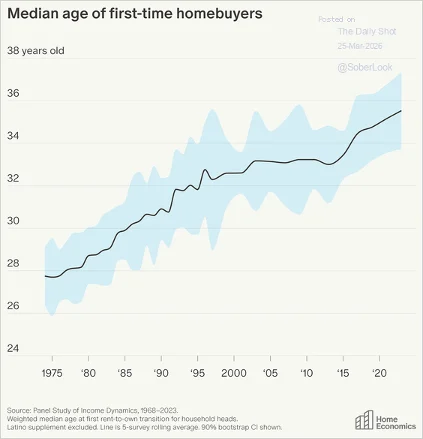
The headlines say the economy is holding up. The data tells a more complicated story. Business activity slowed to an eight-month low in March. Unit labor costs were revised sharply higher. Housing affordability remains out of reach for most first-time buyers, with the median purchase age now at 35. Treasury yields are surging, global bond markets just suffered their worst month since 2022, and futures markets are now pricing in a Fed rate hike by year-end — not a cut. If you’re within five to ten years of retirement, these aren’t abstract indicators. They’re the conditions your income plan has to be built to survive.
US Economy
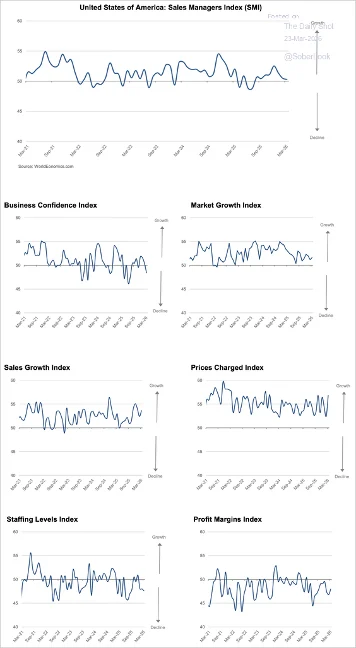
Business activity slowed in March, with the Sales Manager Index slipping to an eight-month low, near stagnation. Business confidence fell into contraction amid concerns about the Middle East conflict, while firms raised prices and cut staffing.
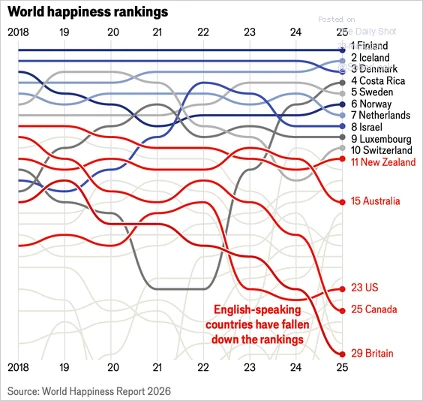
World happiness rankings:
Indoor living area per person in the US:
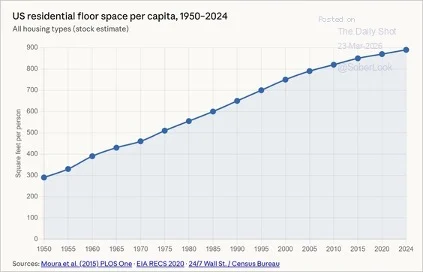
Source: @ramez Read full article
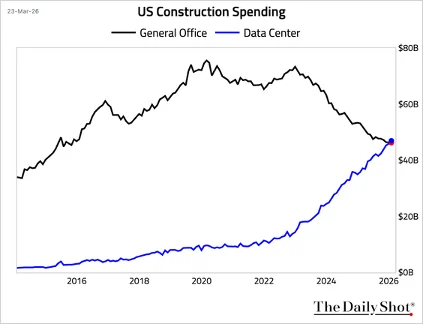
Construction spending on data centers continues to rise and has surpassed spending on office construction.
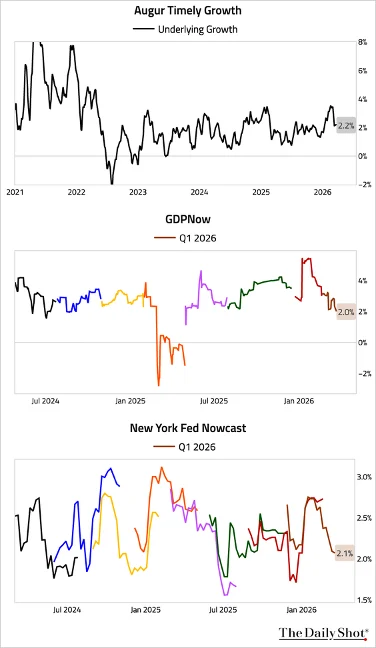
Economic growth is at or slightly above potential growth (2%), according to a variety of nowcasting models.
Tax refunds are about 12% higher than last year, with the percentage increase trending upward over the past few weeks.
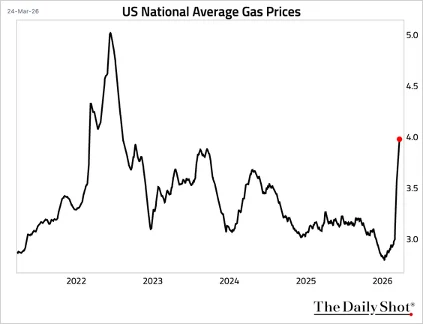
US national average regular gas price has reached $3.977.
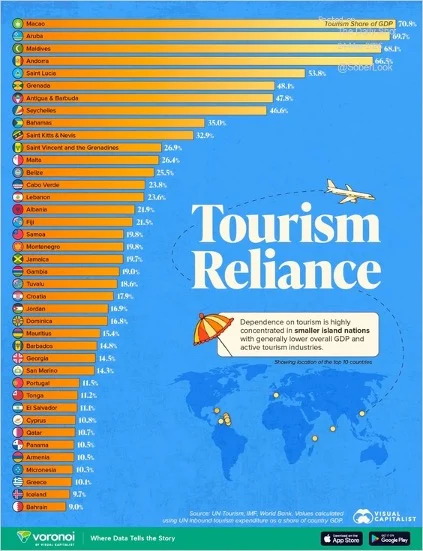
Here are the countries most dependent on tourism.
The Richmond Fed Manufacturing Index improved more than expected. The gain was driven by better shipments and new orders, though future expectations declined for both indicators.
Employment improved as well, with forward expectations jumping to the highest level since late 2023. Prices paid fell while prices received rose, pointing to margin expansion. The Richmond Fed’s services revenue index surged back into expansionary territory.
The Redbook index of same-store sales accelerated. However, Q4 2025 nonfarm productivity was revised down from 2.8% to 1.8%.
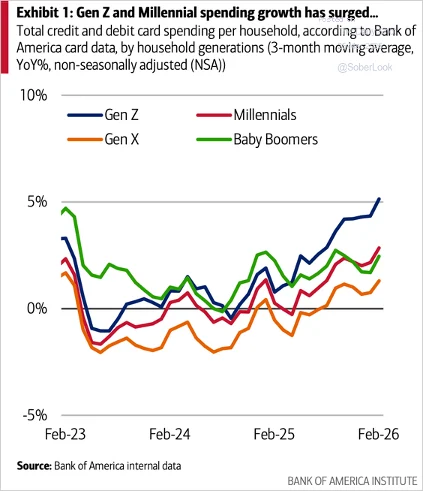
Unit labor costs—compensation divided by output—were revised sharply higher from 2.8% to 4.4%. Gen Z and Millennial spending growth has rebounded sharply, overtaking older cohorts by late 2025 after prolonged periods of underperformance, according to Bank of America card data. Strong after-tax wage growth for Gen Z and Millennials has likely supported the recent acceleration in their spending.
Longitudinal data show the median age of first-time homebuyers is 35 years.
The current account deficit narrowed in Q4 2025. Despite concerns about tariff policy and uncertainty, the CFO outlook for the economy improved in Q1, with expectations for GDP and business revenue growth over the next year remaining solid.
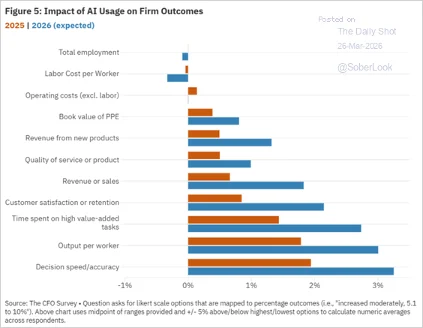
Firms report that AI’s largest realized benefits include improved efficiency, faster decision-making, and higher output, with impacts expected to strengthen further in 2026.
On average, sectors with higher AI adoption have shown a more significant deceleration in wage growth.
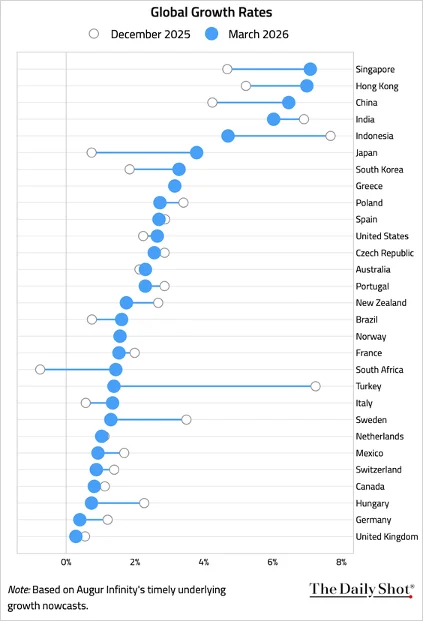
Here’s how growth has shifted by country since the start of the year.
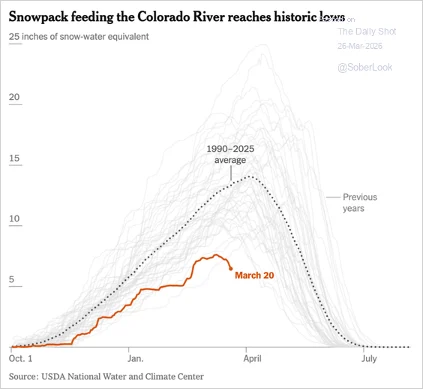
With a heatwave hitting the West Coast of the United States, snowpack feeding the Colorado River has reached historic lows.
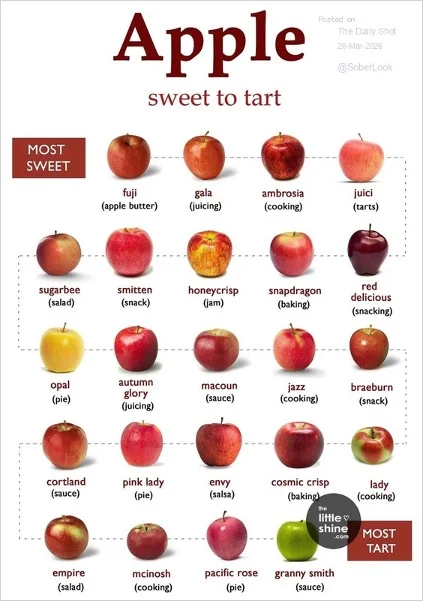
This chart ranks apple varieties from sweetest to most tart.
US Stock Market
Analysts continue to raise their EPS forecasts for 2026. Growth in forward EPS has been accelerating.
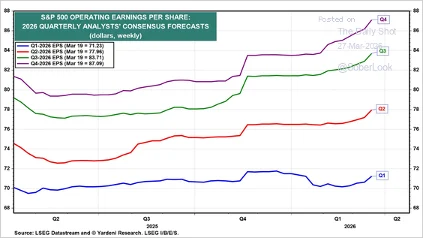
Source: Yardeni Research
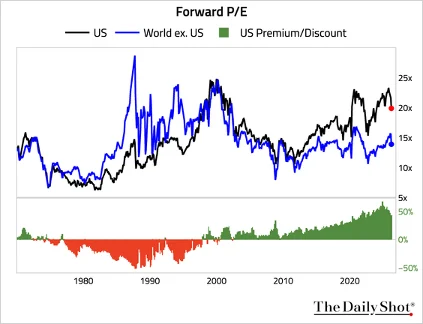
US equities are trading at a 40% premium to the rest of the world.
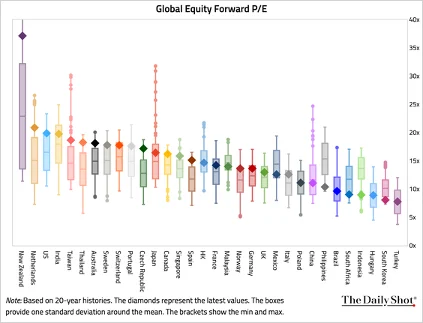
Here’s global equity valuation by country.
38.4% of S&P 500 stocks are down 20% or more from their 52-week highs.
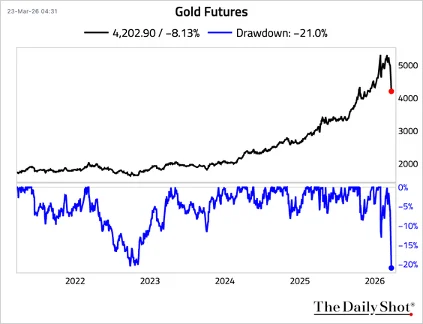
Gold futures slumped into a bear market, …
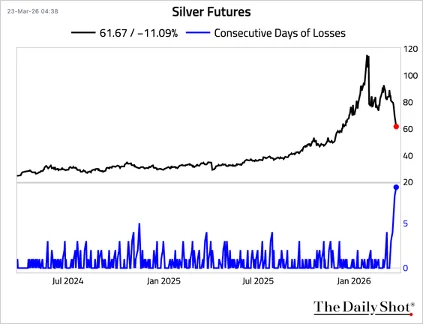
Silver is down 48% from it’s high.
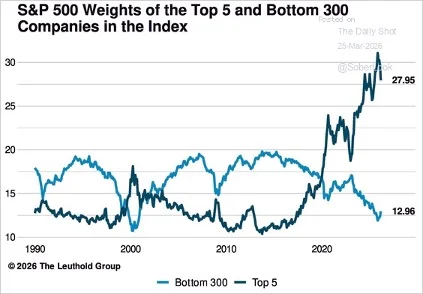
The top five stocks still account for 28% of the S&P 500, while the bottom 300 make up only 13%.
The Fed
Until this month the futures market was indicating strong odds the Fed would cut interest rates this year – something like 70% going into March vs. 10% odds of a rate increase. This has now changed, with market expectations tilting toward higher rates.
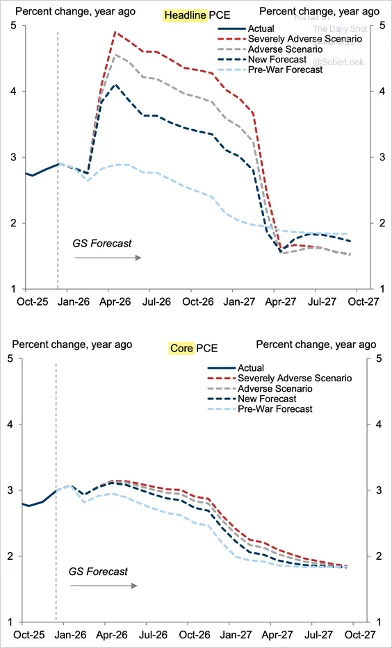
One reason for this is that “real” interest rates will actually fall as the Middle East situation pushes inflation higher. That would risk opening the door for yet more inflation. The Fed will have to tighten just to keep real rates steady as inflation rises. All this may not matter if the war is somehow resolved soon. Fed officials may not be willing to make that bet, though.
Deutsche Bank forecasts US CPI to hit 3.81% in April and 4.02% in May. With the Fed funds rate at 3.64%, these rising inflation projections are expected to push the real policy rate into negative territory next month for the first time since April 2023.
Global bond markets have lost more than $2.5 trillion in March—the largest monthly drop since 2022.
Iran and World Oil
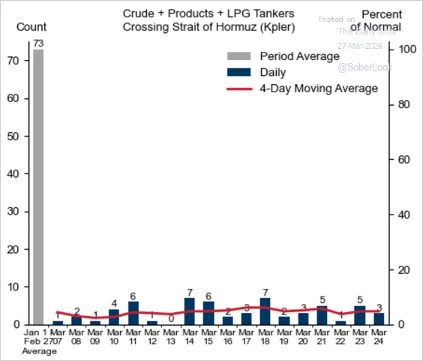
Strait of Hormuz crossings remain limited.
Source: Goldman Sachs
Among oil tankers that crossed the Strait of Hormuz from the Persian Gulf, 46% were from Iran. The estimated total disruption to oil flows from the Persian Gulf stands at 15 million barrels per day (15 times larger than the peak April 2022 disruption to Russian oil production).
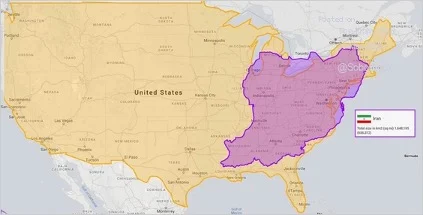
The size of Iran:
Source: u/mapoman via Adam Tooze
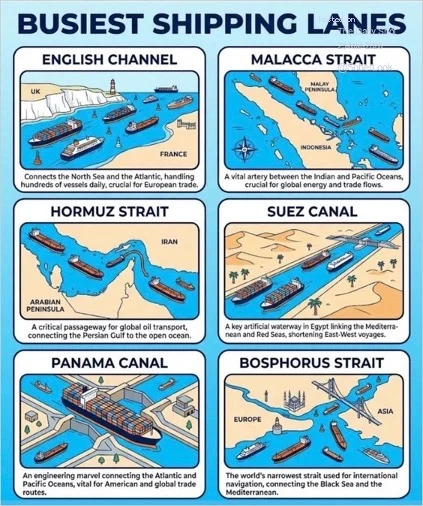
Busiest shipping lanes:
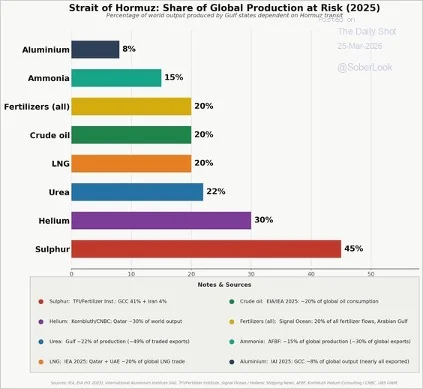
This chart shows the proportion of global production of major commodities that transited through the Strait of Hormuz in 2025.
This chart shows the number of ships passing through the Strait of Hormuz each day this year. The count was generally in the 50-70 range in January and February. In march it’s been single digits and often zero.
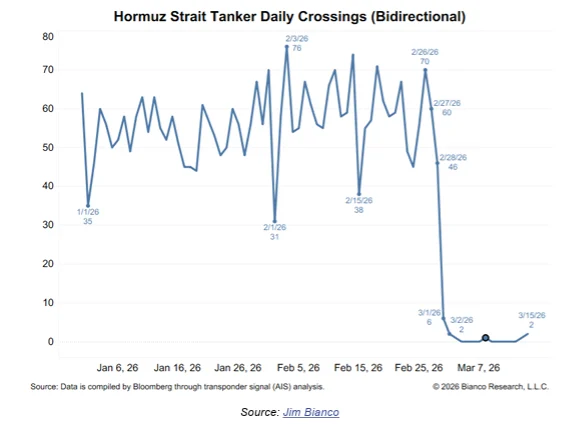
There is a twist, though. The data only includes ships that broadcast their location through the AIS transponder system. There are reports that some vessels have transited the strait with their transponders turned off, so the real number is probably a bit higher. But it’s certainly nowhere near normal. And it’s anyone’s guess when normalcy will return.
Inflation in Iran is currently around 47.5% annually, with food prices up over 100%. The 10 million rial note, issued in March 2026, is the largest denomination in Iranian history. It followed a 5 million rial note introduced just a month earlier (early Weimar, Argentina, or Zimbabwe?).
Long lines formed at banks when it was released, and supplies ran out quickly. The note is worth about seven dollars. It has been two months since much of the military has been paid, although the IRGC seems to be getting their money. Not the best context for military cohesion.
Great Quotes
“Great works are performed not by strength, but perseverance.” — Samuel Johnson
Picture of the Week
Dragonfly on blossom

All content is the opinion of Brian Decker